
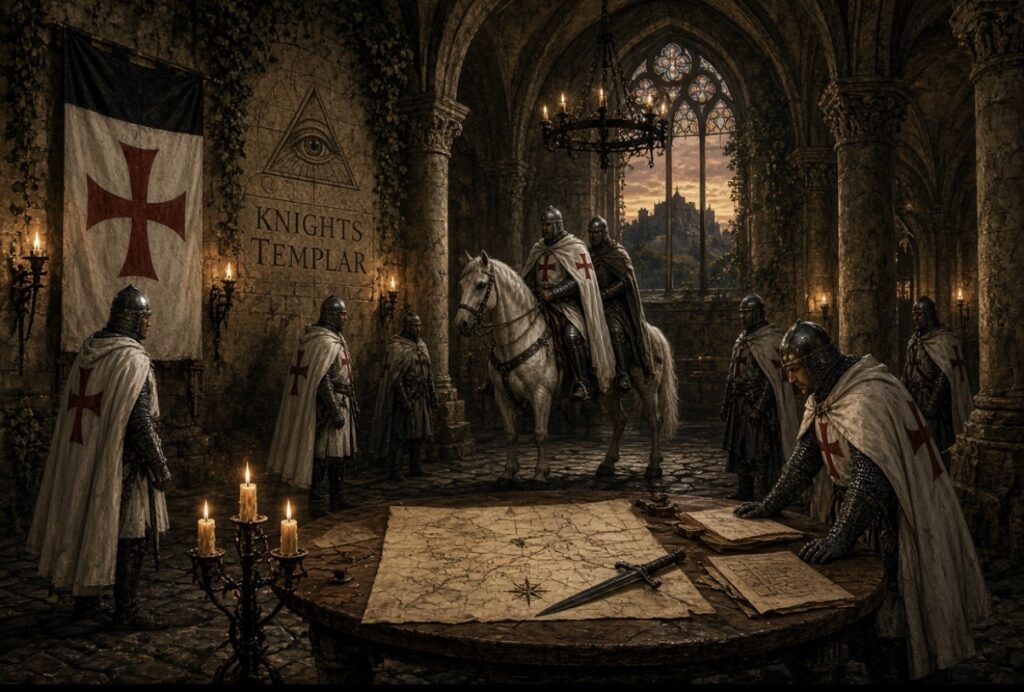
The Knights Templar, formally known as the Poor Fellow-Soldiers of Christ and of the Temple of Solomon, were a medieval religious and military order founded in the early twelfth century. Although they later became associated with immense wealth, secret rituals, hidden treasure, and conspiracy theories, the historical Templars were primarily a Catholic institution created to protect pilgrims traveling to the Holy Land. Their story combines religion, warfare, medieval finance, political power, and a dramatic collapse that has continued to inspire speculation for centuries.
The order was established around 1119 by a small group of knights led by Hugh de Payns, a French nobleman. The knights took religious vows of poverty, chastity, and obedience and dedicated themselves to protecting Christian pilgrims in the Latin Kingdom of Jerusalem. King Baldwin II of Jerusalem granted them quarters near the Temple Mount, which contributed to their name. The location was traditionally associated with Solomon’s Temple, although the Templars did not build the original temple and did not possess proven knowledge of hidden biblical treasures.
At the Council of Troyes in 1129, the Templars received formal recognition from the Catholic Church. Bernard of Clairvaux, an influential Cistercian abbot, strongly supported the order and helped establish its religious rule. This approval transformed the Templars from a small military brotherhood into an international institution. Their members followed a strict hierarchy that included knights, sergeants, chaplains, and various servants or employees. Knights were generally drawn from the nobility and wore the recognizable white mantle marked with a red cross. Sergeants, who were often non-noble, served as cavalrymen, infantry soldiers, administrators, or skilled laborers and commonly wore darker clothing.
The Templars’ principal mission was military defense. They built and garrisoned fortresses, escorted travelers, defended strategic roads, and participated in major battles involving the Crusader states. Their strongholds included castles such as Safed, Tortosa, and Atlit. They were known for discipline, organization, and willingness to hold strategically important positions, sometimes despite overwhelming odds. Their military identity, however, represented only one part of their activities. The Templars also owned farms, vineyards, mills, workshops, ports, and urban properties throughout Europe and the eastern Mediterranean.
One of the lesser-known aspects of the Templars was their role in medieval financial services. Pilgrims could deposit money with a Templar house in Europe and receive documentation that allowed them to withdraw funds in the Holy Land. This reduced the danger of carrying gold and silver across long and dangerous routes. The order also administered estates, collected rents, transported valuable goods, and managed donations made by nobles and monarchs. It was not a modern bank, but its network functioned in ways that resembled banking, especially through secure transfers, estate management, and credit arrangements.
The Templars became wealthy because European nobles donated land, money, horses, weapons, and legal privileges to them. Their wealth was not necessarily stored as one enormous treasure. Instead, it was distributed across a large network of commanderies, farms, fortresses, churches, and financial holdings. A commandery was a local administrative center that collected revenue and supplied personnel and materials to the order. The Templars’ international structure allowed them to transfer resources between regions, which made them powerful but also made their finances difficult for outsiders to understand.
Their organization was governed by a grand master, who served as the order’s chief military, administrative, and religious leader. The grand master was assisted by senior officers, including marshals, commanders, treasurers, and regional officials. Important decisions were made through chapters and councils, and the order’s rule regulated clothing, food, behavior, military conduct, and religious practices. Contrary to later legends, there is no reliable evidence that the entire organization was controlled by a secret inner society devoted to occult beliefs. Much of the order’s secrecy resulted from normal medieval military and religious confidentiality, along with the destruction or loss of many records.
The Templars suffered a major strategic decline after Christian forces lost Jerusalem in 1187 and were gradually pushed out of much of the Holy Land. They relocated their central operations to cities such as Acre, Cyprus, and eventually territories connected to their European network. The fall of Acre in 1291 marked the end of major Crusader rule in the Holy Land. Without a permanent Christian kingdom to defend, the Templars’ original purpose became less clear. Their continued wealth and independence also caused increasing political resentment.
King Philip IV of France played the central role in the order’s destruction. Philip was deeply indebted to the Templars and sought greater control over their financial resources. On October 13, 1307, he ordered the arrest of Templars throughout France. The prisoners were accused of heresy, blasphemy, sexual misconduct, and denying Christ. Many confessions were obtained through torture or threats, making the reliability of the accusations highly questionable. Pope Clement V initially resisted the French king but eventually began proceedings against the order across Europe.
The Council of Vienne formally suppressed the Templars in 1312, although the pope stopped short of declaring that every accusation had been proven. The order’s property was generally transferred to the Knights Hospitaller, though the exact outcome varied by region. In France, the last grand master, Jacques de Molay, was executed in 1314 after retracting his confession. His death helped create the later legend that he cursed the king and the pope. However, historians debate the exact details of his final statements.
A major difficulty in studying the Knights Templar is determining what is genuinely unknown. Many popular claims—that they discovered the Holy Grail, possessed the Ark of the Covenant, founded modern banking, worshiped a mysterious idol called Baphomet, or survived secretly into the modern era—lack reliable contemporary evidence. The word “Baphomet,” for example, appeared in accusations during the trials, but the surviving records do not establish that the Templars practiced a unified secret religion. Some documents were lost, some trial records were incomplete, and many surviving accounts were produced by enemies or under coercive conditions.
The Templars’ real historical importance is therefore more substantial than their legends. They helped create an international model of religious organization, military administration, property management, and long-distance financial coordination. Their downfall demonstrated the vulnerability of powerful institutions when they lacked an independent territorial state and depended on cooperation from monarchs and the papacy. Although the order disappeared in the early fourteenth century, its historical image survived because it combined wealth, religious devotion, military power, political conflict, and unresolved questions. The most accurate understanding of the Knights Templar separates documented medieval history from later speculation while recognizing that the surviving evidence still leaves important aspects of their organization and private life uncertain.





2 thoughts on “The Knights Templar: History, Organization, and Lesser-Known Facts”
Great piece on the Templers. I’ve studied them for years.
Very interesting. Great, well organized and concise synopsis. I knew very little about them except the broader legends.