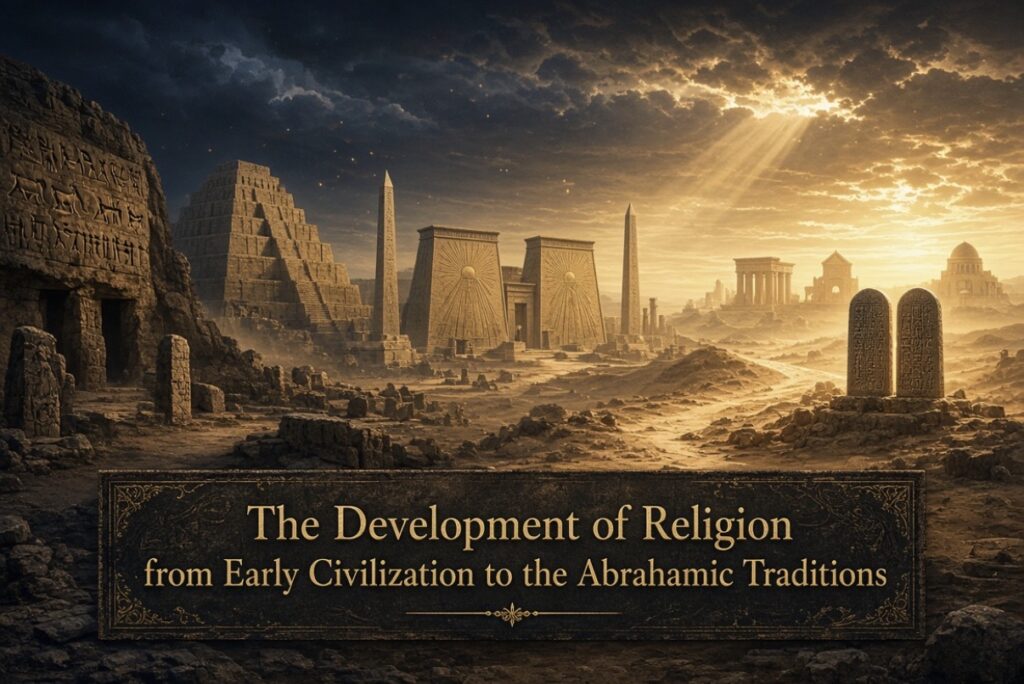
Religion has existed in many forms since the beginning of human civilization. Because thousands of religious traditions have developed across different cultures, it is impossible to describe every belief system in a single essay. However, the major stages of religious history can be organized chronologically, beginning with prehistoric spiritual practices, continuing through the religions of the first civilizations, and leading into the Abrahamic traditions of Judaism, Christianity, and Islam.
The earliest known religious practices developed before written history. Prehistoric communities appear to have practiced animism, the belief that animals, plants, natural forces, and objects possessed spirits. Evidence from burials suggests that early humans believed in some form of existence after death. Cave paintings, burial offerings, and carved figures may also indicate rituals connected to fertility, hunting, ancestors, or protection. These early beliefs were not organized religions with formal scriptures or institutions, but they established important religious ideas such as sacred places, spirits, ritual behavior, and life after death.
With the rise of civilization in Mesopotamia, Egypt, the Indus Valley, and China, religious systems became more structured. In ancient Mesopotamia, the Sumerians worshiped gods such as Anu, Enlil, Inanna, and Enki. Their religion was polytheistic, meaning that they believed in many gods who controlled nature, cities, fertility, war, and political authority. Temples called ziggurats were built as religious and economic centers. The Akkadians, Babylonians, and Assyrians later adopted and developed many Mesopotamian religious ideas.
Ancient Egypt also developed a complex polytheistic religion. Egyptians worshiped gods including Ra, Osiris, Isis, Horus, and Anubis. Their religious beliefs emphasized balance, or ma’at, the afterlife, and the preservation of the body through mummification. Pharaohs were considered divine or closely connected to the gods. Egypt briefly experienced an attempt at monotheistic or henotheistic reform under Pharaoh Akhenaten, who promoted the worship of the sun disk Aten during the fourteenth century BCE. However, this religious change did not survive after his death, and traditional Egyptian worship returned.
In ancient India, the Vedic religious tradition developed among Indo-Aryan-speaking communities beginning around the second millennium BCE. The Vedic religion honored deities such as Indra, Agni, and Varuna through hymns and sacrifices. Over time, these traditions developed into Hinduism, one of the world’s oldest continuously practiced religions. Hinduism includes beliefs in karma, reincarnation, dharma, and liberation from the cycle of rebirth. It contains both polytheistic and philosophical traditions, including forms of monism and devotion to one supreme deity.
Ancient China developed traditions centered on ancestor worship, nature, social harmony, and the Mandate of Heaven. Later, Confucianism emphasized moral behavior, family responsibility, education, and social order, while Daoism taught harmony with the Dao, or the natural way of the universe. Although Confucianism is often described as a philosophy rather than a religion, both traditions influenced Chinese religious life. Buddhism later emerged in India during the fifth or fourth century BCE through the teachings of Siddhartha Gautama, the Buddha. Buddhism taught that suffering is caused by attachment and can be overcome through ethical conduct, meditation, and wisdom.
Zoroastrianism developed in ancient Iran through the teachings of Zarathustra, or Zoroaster. Its exact date is debated, but many scholars place Zarathustra somewhere between the second and first millennia BCE. Zoroastrianism is centered on Ahura Mazda, the wise Lord, and teaches a moral struggle between truth and falsehood, often represented by the opposition between good and destructive forces. It emphasizes human freedom, ethical choice, judgment after death, and the eventual triumph of good.
Zoroastrianism is sometimes described as the first monotheistic religion because it presents Ahura Mazda as the supreme creator and source of truth. However, this claim requires qualification. Earlier religious movements, such as Akhenaten’s worship of Aten in Egypt, may also be considered attempts at exclusive devotion to one god. In addition, Zoroastrianism contains strong dualistic themes, especially the conflict between beneficial and destructive spiritual powers. For this reason, historians do not universally agree that it was absolutely the first monotheistic religion. It is more accurate to say that Zoroastrianism was one of the earliest major traditions to develop a powerful and lasting concept of one supreme moral God.
The Abrahamic religions trace their spiritual ancestry to Abraham, a patriarch described in the Hebrew Bible, Christian Bible, and Qur’an. Judaism is generally considered the oldest of the three major Abrahamic religions. It developed among the ancient Israelites and emphasized a covenant between God and the Jewish people. Judaism taught that there is one God who created the universe and provided moral and religious laws, especially through the Torah. Unlike many earlier religions, Israelite religion increasingly rejected the worship of other gods and developed a strong concept of ethical monotheism.
Christianity emerged in the first century CE from the teachings of Jesus of Nazareth, who was Jewish. Christians believe that Jesus is the Messiah and Son of God and that his death and resurrection provide salvation. Christianity retained Jewish monotheism but developed the doctrine of the Trinity: one God understood as Father, Son, and Holy Spirit. It spread throughout the Roman Empire and eventually became one of the world’s largest religions.
Islam began in seventh-century Arabia through the teachings of the Prophet Muhammad. Muslims believe that Muhammad received revelations from God through the angel Gabriel, which became the Qur’an. Islam teaches absolute monotheism, known as tawhid, and recognizes many figures from Jewish and Christian tradition, including Abraham, Moses, and Jesus. Muslims regard Muhammad as the final prophet. The religion emphasizes belief in one God, prayer, charity, fasting, pilgrimage, and ethical conduct.
Religious history, therefore, developed from early spiritual beliefs about nature and ancestors into organized temple religions, philosophical traditions, ethical systems, and universal faiths. Zoroastrianism played an important role in the development of ideas about one supreme God, moral choice, judgment, heaven, hell, and the final triumph of good. Although it cannot be proven with complete certainty that Zoroastrianism was the first monotheistic religion, it strongly influenced the religious environment from which the Abrahamic traditions developed. Judaism, Christianity, and Islam each created distinctive interpretations of one God while sharing important themes of revelation, morality, prophecy, judgment, and human responsibility