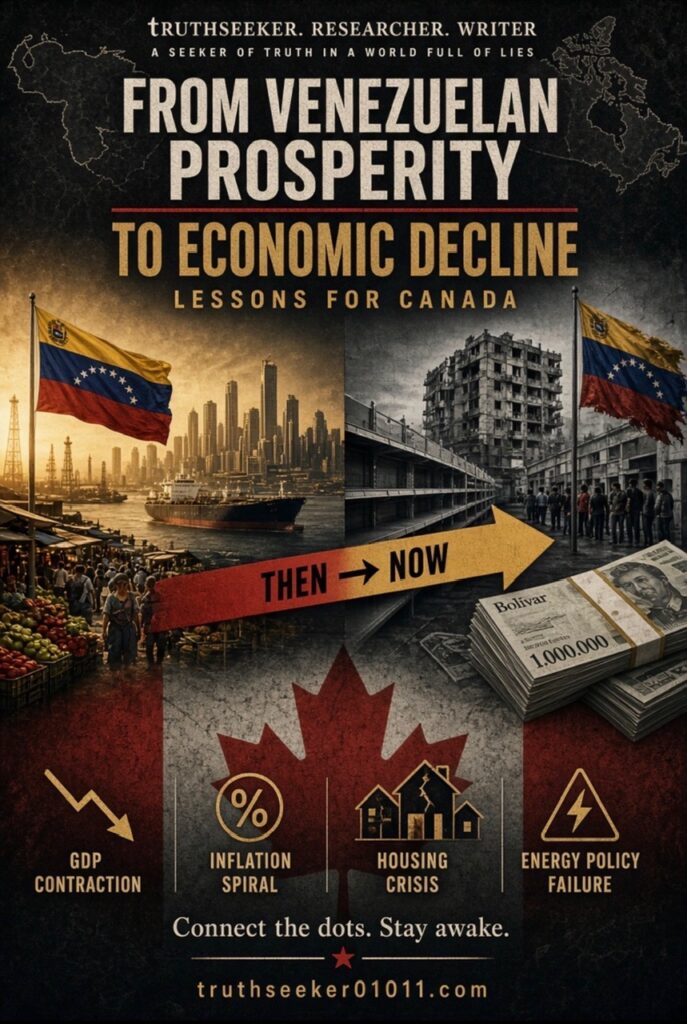
Venezuela’s collapse is often described as a story of a prosperous, oil-rich country that embraced socialism and became impoverished. That description is broadly correct, but the full truth is more complicated. Venezuela did not fall because of one election or one political slogan. Its decline was caused by decades of dependence on oil, corruption, weak institutions, irresponsible government spending, nationalization of productive industries, and the gradual destruction of democratic accountability. Hugo Chávez and Nicolás Maduro accelerated those trends, turning economic weakness into political authoritarianism and national disaster.
Canada is not Venezuela, and it is not currently a communist country. Canada still has strong democratic institutions, private property rights, an independent judiciary, a stable banking system, and a diversified economy. However, Canada is experiencing a serious decline in affordability, productivity, living standards, public services, and institutional confidence. The warning from Venezuela is not that Canada will suddenly become identical to Venezuela. The warning is that countries can lose prosperity gradually when governments spend beyond their means, discourage investment, increase dependence on government programs, ignore productivity, and refuse to correct failing policies.
Venezuela was once one of Latin America’s most prosperous countries. Its vast oil reserves generated enormous government revenue, especially during periods of high global oil prices. That money financed highways, schools, hospitals, public housing, subsidies, and a growing urban middle class. Venezuela attracted immigrants and enjoyed living standards that compared favorably with much of the region.
Yet Venezuelan prosperity was built on a fragile foundation. The country depended excessively on oil exports and failed to develop a diverse economy. When oil prices were high, the government could provide generous benefits without creating a productive economy capable of sustaining them. When oil prices fell, the country’s weaknesses became obvious. Instead of using oil wealth to build durable institutions and competitive industries, Venezuelan governments often treated oil revenue as an unlimited source of political spending.
Before Chávez, Venezuela already suffered from corruption, inequality, and public distrust. Traditional political parties had become disconnected from many citizens. Poverty and inflation weakened confidence in the political system. Chávez rose to power by promising to punish corrupt elites and restore dignity to ordinary Venezuelans. His message was politically effective because it addressed real problems.
At first, Chávez’s government appeared successful. High oil prices allowed it to expand social programs, subsidize food and fuel, increase public employment, and fund housing and healthcare initiatives. Millions of Venezuelans benefited in the short term. This is important because the Venezuelan model did not initially appear to be a failure. It appeared to be delivering social justice.
The problem was that the government increasingly replaced economic production with political distribution. Private companies were nationalized, businesses faced expropriation, and government officials gained greater control over employment, contracts, imports, and access to foreign currency. The oil industry was politicized and poorly managed. Experienced workers were dismissed, investment declined, and maintenance was neglected. Venezuela continued spending as if high oil prices would last forever.
At the same time, Chávez weakened the institutions that could have restrained him. The executive branch gained power over the courts, the legislature, the electoral system, and much of the media. Political opponents faced intimidation, legal pressure, or imprisonment. The government increasingly treated criticism as disloyalty. Although Venezuela was frequently described as “communist,” it is more accurate to call it an authoritarian socialist state with extensive government control over the economy. It retained some private businesses, but political power and economic opportunity became concentrated in the hands of the ruling movement.
When oil prices collapsed in the mid-2010s, Venezuela could no longer hide its structural weaknesses. Government revenue plunged, but spending continued. The state borrowed heavily and created money to cover its obligations. The result was hyperinflation, which destroyed savings and wages. Shortages of food, medicine, electricity, and basic goods spread across the country. Millions of Venezuelans eventually fled.
The economic collapse was accompanied by political repression. Rather than permit a genuine change in leadership, the government under Nicolás Maduro tightened its control. Elections became increasingly disputed, opposition leaders were persecuted, and protests were suppressed. Venezuela therefore lost both economic freedom and democratic accountability. Its collapse was not simply the result of “socialism” in the abstract. It resulted from a specific combination of centralized economic control, oil dependence, corruption, fiscal irresponsibility, institutional destruction, and authoritarian rule.
Canada is now facing a different but increasingly serious problem. The country is not experiencing Venezuelan-style hyperinflation or dictatorship. However, many Canadians can reasonably argue that the country is moving downhill in important ways. Economic growth has become weak on a per-person basis, housing costs have become unaffordable, productivity growth has been poor, public services are under pressure, and younger Canadians increasingly doubt that they will achieve the standard of living enjoyed by previous generations.
Housing is one of the clearest signs of decline. Canada’s housing agency has stated that returning affordability to 2019 levels would require approximately 430,000 to 480,000 new homes annually for the next decade—roughly double the projected construction rate. The problem is not limited to Toronto and Vancouver. It reflects years of insufficient construction, restrictive zoning, slow approvals, high costs, population growth, and inadequate infrastructure. (cmhc-schl.gc.ca)
This has created a society in which employment no longer guarantees financial security. Young people can work full-time and still be unable to buy a home. Rent consumes a large share of household income. Families delay having children, moving, or pursuing education because housing absorbs so much of their earnings. A country that cannot provide attainable housing to working citizens is experiencing a genuine decline in social mobility.
Canada also faces a productivity problem. The Bank of Canada has noted that annual labour-productivity growth averaged roughly 3 percent in the 1960s and 1970s but fell to approximately 1 percent between 2000 and 2019. Productivity matters because it determines whether wages can rise without causing inflation and whether public services can improve without constantly increasing taxes. (bankofcanada.ca)
This is a crucial parallel with Venezuela. Venezuela consumed its oil wealth rather than building a resilient, productive economy. Canada risks consuming its existing advantages—natural resources, educated workers, strong institutions, and access to the American market—without making the investments and reforms needed to remain competitive. Canada has relied heavily on real estate, population growth, government spending, and resource exports while business investment and productivity have lagged.
Population growth without sufficient housing and infrastructure can also reduce living standards. Economic growth may look positive in total numbers while the average person becomes poorer. Recent Canadian economic commentary has acknowledged that growth can be essentially flat on a per-person basis even when total GDP increases. (bankofcanada.ca) This distinction matters. A larger economy does not automatically mean a more prosperous country if the population grows faster than housing, infrastructure, healthcare capacity, and productivity.
Government spending is another area of concern. Social programs are important, and governments have a legitimate role in healthcare, infrastructure, education, and support for vulnerable citizens. But permanent spending commitments must be matched by permanent economic capacity. Borrowing to respond to an emergency is different from borrowing indefinitely to avoid difficult decisions. If debt rises while productivity remains weak, governments eventually face higher interest costs, increased taxes, reduced services, or inflationary pressure.
Canada’s deterioration is also political. Many citizens have lost confidence in governments, media organizations, experts, and major institutions. They see rising taxes, expensive housing, deteriorating healthcare access, excessive bureaucracy, and weak accountability. When people believe that leaders are insulated from the consequences of their decisions, political polarization grows. This resembles Venezuela’s earlier stage—not because Canada has become authoritarian, but because public frustration and distrust can create an opening for leaders who promise radical solutions.
The most important lesson is that decline usually happens gradually. Venezuela did not become impoverished overnight. First, institutions weakened. Then productive businesses were politicized. Then government spending became dependent on resource revenue. Then inflation and shortages appeared. Finally, political repression made peaceful correction difficult. Canada has not reached those final stages, but the early warning signs of stagnation and institutional distrust should not be dismissed.
The honest conclusion is that Canada is in decline relative to its potential, even though it remains far wealthier, freer, and more stable than Venezuela. The country still has the ability to reverse course. That will require building far more housing, reducing unnecessary regulation, encouraging investment, improving productivity, protecting free expression, controlling spending, maintaining sound money, and making immigration levels consistent with infrastructure capacity. It will also require political leaders to admit that policies producing poor results must change.
Canada does not need to become Venezuela for Canadians to be justified in demanding reform. The relevant question is not whether Canada is already a communist dictatorship. It clearly is not. The relevant question is whether Canada is becoming less affordable, less productive, less competitive, and less confident in its future. On those measures, the evidence is troubling. Venezuela’s history shows what can happen when leaders spend prosperity instead of creating it and weaken institutions instead of repairing them. Canada still has time to choose a different path—but avoiding Venezuela’s ultimate collapse will require confronting Canada’s current decline rather than denying it.