

A country does not lose its soul all at once.
It happens slowly.
It happens when people learn to say the right things while thinking something entirely different. It happens when politeness becomes more important than honesty, when fitting in becomes more valuable than standing for something, and when a society becomes so obsessed with appearing kind that it forgets what genuine kindness actually requires.
The greatest danger to a society is not always hatred. Sometimes it is something much quieter: conformity disguised as civility.
Canada provides a compelling example of this contradiction—not because every Canadian is insincere or every institution is corrupt, but because the country’s reputation for politeness, tolerance, and moderation can sometimes conceal a deeper social pressure to avoid confrontation, suppress individuality, and maintain appearances at almost any cost.
There is a profound difference between kindness and niceness.
Kindness requires courage. It means telling someone the truth when the truth is uncomfortable. It means defending someone when doing so is unpopular. It means allowing another person to succeed without feeling personally diminished by their success. It means accepting that someone can be different from you without requiring them to become less different.
Niceness, on the other hand, can be nothing more than social performance.
Niceness says, “Everything is fine,” when everything is not fine.
Niceness smiles while resentment grows underneath.
Niceness avoids difficult conversations because discomfort is considered worse than dishonesty.
Eventually, a culture built around this kind of niceness can become emotionally dishonest. People learn how to perform acceptance without necessarily practicing it. They learn the vocabulary of inclusion, compassion, and tolerance, while simultaneously developing an unwritten set of rules about who is allowed to stand out, who is allowed to succeed, and how much individuality is socially acceptable.
This is where conformity becomes dangerous.
Conformity does not always arrive wearing the uniform of authoritarianism. Sometimes it arrives wearing a smile.
It tells you that you are free to be yourself—as long as being yourself does not make anyone uncomfortable.
It tells you that ambition is admirable—as long as you do not become so ambitious that others begin comparing themselves to you.
It tells you that individuality is celebrated—as long as your individuality remains within the boundaries of what everyone else considers acceptable.
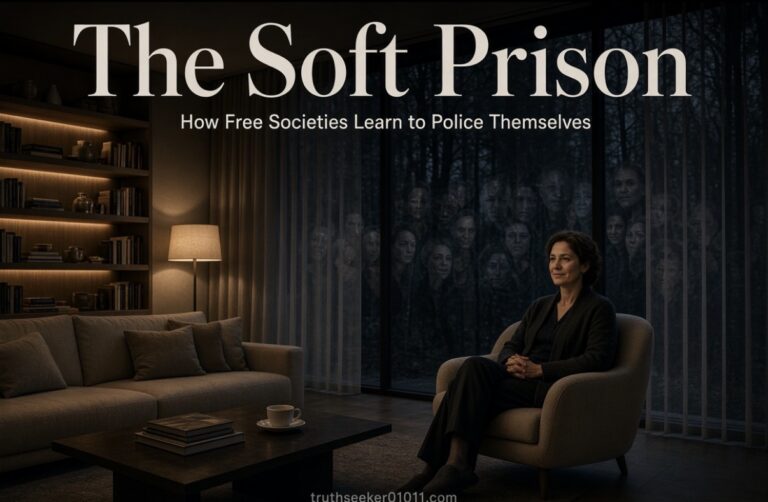
And this creates a peculiar form of social control: nobody has to explicitly tell you to become smaller. You simply learn, through years of subtle reactions, what happens when you become too loud, too ambitious, too independent, too successful, too unconventional, or too unwilling to participate in the performance.
Eventually, you police yourself.
That may be the most effective form of conformity there is.
A person does not need to be physically imprisoned if they have been psychologically trained to fear stepping outside the boundaries of acceptance.
This is particularly damaging to a country because nations depend upon people who are willing to challenge assumptions.
Every meaningful advancement begins with someone who refuses to accept that the existing arrangement is good enough. Entrepreneurs challenge established industries. Artists challenge cultural conventions. Scientists challenge accepted explanations. Reformers challenge institutions. Leaders challenge complacency.
Progress requires friction.
But a culture that worships social harmony can begin to interpret friction itself as a problem.
The person asking difficult questions becomes “negative.”
The ambitious person becomes “arrogant.”
The outspoken person becomes “difficult.”
The person who refuses to participate in social games becomes “cold.”
The person who succeeds dramatically becomes someone others quietly resent.
And eventually, the culture begins rewarding those who are easiest to live with rather than those who have the courage to make things better.
That is how mediocrity can become self-perpetuating.
When people fear standing out, exceptional individuals are pressured to minimize themselves. When exceptional individuals minimize themselves, fewer people see what is possible. When fewer people see what is possible, ambition declines. And when ambition declines, the society begins confusing stability with progress.
This does not mean that ambition is automatically virtuous or that every unconventional person is correct. Individualism without responsibility can be destructive too. The point is that a healthy society needs room for disagreement, excellence, eccentricity, failure, experimentation, and uncomfortable truth.
It needs people who can say, “I disagree.”
It needs people who can say, “This isn’t working.”
It needs people who can say, “I want more.”
And it needs a culture mature enough not to interpret those statements as personal attacks.
This is why fake kindness can be more destructive than open hostility.
Open hostility reveals itself.
You know where you stand with someone who tells you they dislike you.
Performative kindness is harder to confront because it creates the illusion of harmony. The words are pleasant. The smiles are present. The social rituals are intact. But underneath, resentment can continue to grow.
And when nobody is allowed to acknowledge that resentment, it becomes part of the culture.
People learn to communicate indirectly. They avoid saying what they mean. They maintain appearances. They gossip instead of confronting. They punish socially instead of speaking honestly. They congratulate one another while privately hoping the other person fails.
The result is not genuine peace.
It is emotional stagnation.
A nation cannot thrive indefinitely on appearances.
Eventually, the distance between what a society says about itself and what people actually experience becomes too large to ignore.
This is why Canada’s reputation for politeness deserves to be examined carefully. Politeness itself is not the problem. It can be wonderful. Courtesy makes everyday life more pleasant. Compassion matters. Social trust matters. The ability to disagree without treating one another as enemies matters.
But politeness becomes destructive when it becomes a substitute for honesty.
A country should not measure its moral character by how pleasant its people sound.
It should measure itself by whether people can tell the truth without being destroyed for doing so.
Can the ambitious person succeed without being shamed for succeeding?
Can the unconventional person exist without being pressured into conformity?
Can someone challenge a popular opinion without becoming socially radioactive?
Can people disagree honestly while still respecting one another?
Can someone be extraordinary without being expected to apologize for it?
These questions matter because the soul of a country is not found in its slogans.
It is found in what happens when someone refuses to follow them.
The tragedy of conformity is that it can convince an entire generation that its limitations are virtues. People begin calling fear “humility.” They call passivity “peace.” They call avoidance “kindness.” They call mediocrity “balance.”
And eventually, nobody remembers that they were once capable of more.
That is the real danger.
A country does not need everyone to think alike. It needs enough freedom for people to think differently. It does not need everyone to be extraordinary, but it needs to allow extraordinary people to exist without demanding that they become ordinary for the comfort of everyone else.
Real kindness should make room for difference.
Real tolerance should survive disagreement.
Real humility should not require self-erasure.
And real national strength should not depend upon everyone pretending that everything is fine.
Perhaps the greatest lesson is this:
A society does not preserve its soul by avoiding every uncomfortable conversation.
It preserves its soul by becoming courageous enough to have them.
Because beneath every smile is a human being, and beneath every polite society are the choices its people make about what they are willing to tolerate, what they are willing to question, and what they are willing to become.
Canada may continue to describe itself as welcoming, tolerant, peaceful, and kind.
But those words only have meaning if they are lived rather than performed.
Because the moment kindness becomes a mask, conformity becomes the price of belonging, and honesty becomes socially dangerous, something fundamental begins to disappear.
Not immediately.
Not dramatically.
Quietly.
The soul of a country rarely dies with a scream.
Sometimes, it dies with a smile





1 thought on “When Kindness Becomes Conformity: How a Nation Can Lose Its Soul”
So well said! The Canada I grew up in is gone. Destroyed by suicidal virtue signaling and political correctness and forced tolerance under the guise of an unrealistic multiculturalism.