Introduction
Major events—climate change, pandemics, war, economic shocks—do more than threaten health and stability. They also reshape how people think, what they fear, what they consider acceptable, and what kinds of policies governments and institutions can introduce quickly. In the public imagination, these shifts can look like “agenda pushing.” Even when actors genuinely believe they are responding to real risks, the same crisis conditions can still create opportunities to advance priorities that go beyond the immediate emergency.
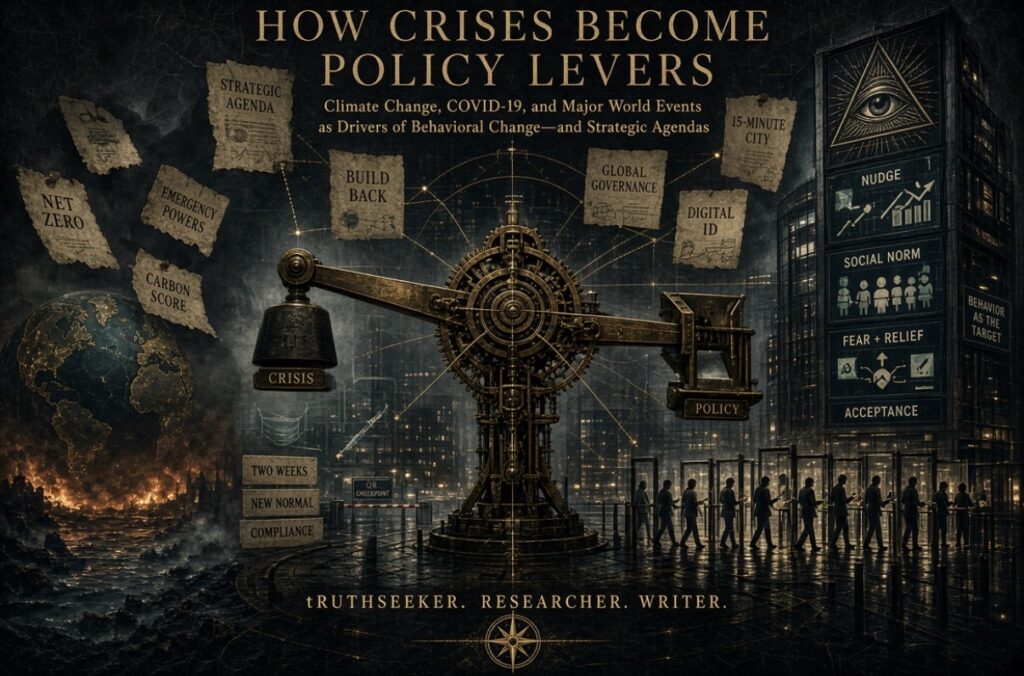
This essay argues that crises often become behavioral change engines through a set of predictable mechanisms: (1) framing and urgency, (2) expansion of state and institutional powers, (3) rapid adoption of new systems and rules, (4) shifting norms and incentives, and (5) consolidation of influence. The result is that public behavior can change substantially—sometimes for good public-safety reasons, and sometimes in ways that persist beyond the crisis itself and benefit particular interests.
—
1) Framing: How “urgent risk” changes what people will tolerate
Behavioral change rarely begins with coercion alone. It begins with how an event is explained. Crisis narratives often emphasize danger, uncertainty, and collective responsibility. This framing matters because it changes the psychological and political baseline: people become more willing to accept restrictions, tradeoffs, and new rules when those appear necessary to prevent harm.
Climate change is an example of a long-running “risk frame.” It’s communicated as an escalating threat, and that communication can shift norms around energy use, travel, purchasing, and personal responsibility. Similarly, COVID-19 was framed as an immediate threat requiring collective compliance; once a population accepts the need for restrictions, the social cost of dissent can rise. In both cases, the event becomes a lens through which institutions interpret society’s problems—and it becomes easier to justify interventions that align with the lens.
Crucially, framing doesn’t automatically mean bad faith. But it does create room for actors to push their preferred solutions: when people accept that “exceptional action is required,” a wide range of proposals can appear reasonable, even if they were already on the table before the crisis.
—
2) The “policy window”: why emergencies accelerate adoption
Political science often points to the idea of a policy window: moments of disruption create openings where reform happens faster than it normally would. During calm periods, proposals face resistance, slow debate, and legal hurdles. During crises, decision-makers can cite urgency, public health necessity, or national security. Even when oversight exists, the speed of implementation can outpace the speed of public understanding.
This acceleration changes behavior in two ways:
1. People must adapt quickly. If rules change fast—mask guidance, movement restrictions, travel limitations, new workplace rules—behavior adjusts through necessity.
2. Institutions build path dependence. Once a policy or infrastructure exists, it tends to persist. Even after a crisis softens, the systems remain, and the governance style can remain.
From the perspective of “agenda pushing,” the key concern is not that emergencies justify any action whatsoever, but that the emergency provides a mechanism to implement changes that are broader than the immediate need. After the crisis, those changes can become normalized.
—
3) Shifting norms: behavioral change through social pressure and legitimacy
Crises also reshape culture—what people consider normal, responsible, and morally acceptable.
During COVID-19, for instance, behavior was influenced by peer pressure, public messaging, and institutional cues (workplaces, schools, media). When large portions of society adopt the same new habits, dissenters can experience social penalties. Over time, the change becomes less about rules and more about identity: people adopt the crisis-related behaviors because the behaviors signal belonging to a “responsible” group.
Climate change messaging functions similarly but over longer timescales. If climate action becomes a marker of modern identity, then individuals may align their choices with that identity—sometimes even when those choices are economically or socially inconvenient—because the cost of being seen as insufficiently aligned rises.
In this sense, crises create “social alignment effects.” Those effects can be beneficial (higher vaccination rates, reduced risky behavior), but they can also be exploited to broaden enforcement of norms beyond what the original emergency required.
—
4) Technology and infrastructure: when crisis unlocks permanent systems
A major pathway for agenda advancement is technological and infrastructural change. Crises often demand rapid logistics, monitoring, and coordination. That can drive adoption of digital tools: contact tracing systems, health passes, remote work infrastructure, supply-chain analytics, and data-driven resource allocation.
Even if the tools are justified in the moment, they can also become long-term governance infrastructure. Once systems exist, they are repurposed: from temporary emergency tracking to broader eligibility management; from targeted public safety to general compliance tracking; from short-term operational needs to durable administrative capabilities.
From a critical viewpoint, the worry is that crisis-driven adoption creates “capability drift.” The system’s capacity increases during the emergency, but the oversight framework may lag behind. Even responsible institutions can underestimate long-run consequences, because the immediate priority is stopping harm right now.
—
5) Incentives and power: who benefits when the rules change?
Behavioral change under crisis is not evenly distributed. Different groups face different burdens and benefits: some people gain access to new services, some acquire market advantages, some gain political power through emergency legitimacy.
This matters for “agenda pushing” because crises often rearrange incentives:
• Companies that can provide crisis solutions expand quickly.
• Industries aligned with recovery spending grow.
• Bureaucracies tasked with enforcement gain influence and funding.
• Political leaders benefit from appearing decisive and competent.
None of this requires a single mastermind. It can happen through normal institutional incentives and competition. Yet the result can still be a perception of coordinated agenda advancement—because outcomes converge around certain priorities even if motives differ.
—
Conclusion
Movements like climate change, COVID-19, and other major world events can change human behavior in predictable ways: they reshape framing and urgency, open policy windows, enforce new norms through legitimacy and social pressure, accelerate adoption of new infrastructure, and redistribute power and incentives. Those behavioral changes can be entirely appropriate responses to genuine risks. But crises can also provide an environment in which broader agendas become easier to implement and harder to challenge—especially when emergency conditions weaken deliberation and strengthen “do something now” politics.
A responsible way to engage this issue is not to assume every change is sinister, nor to dismiss the possibility of opportunism. The key is asking the accountability questions that crises often temporarily blur: What was necessary versus what was convenient? What changed permanently versus temporarily? Who gained influence or market advantage? And what safeguards ensure that emergency powers do not become routine governance?