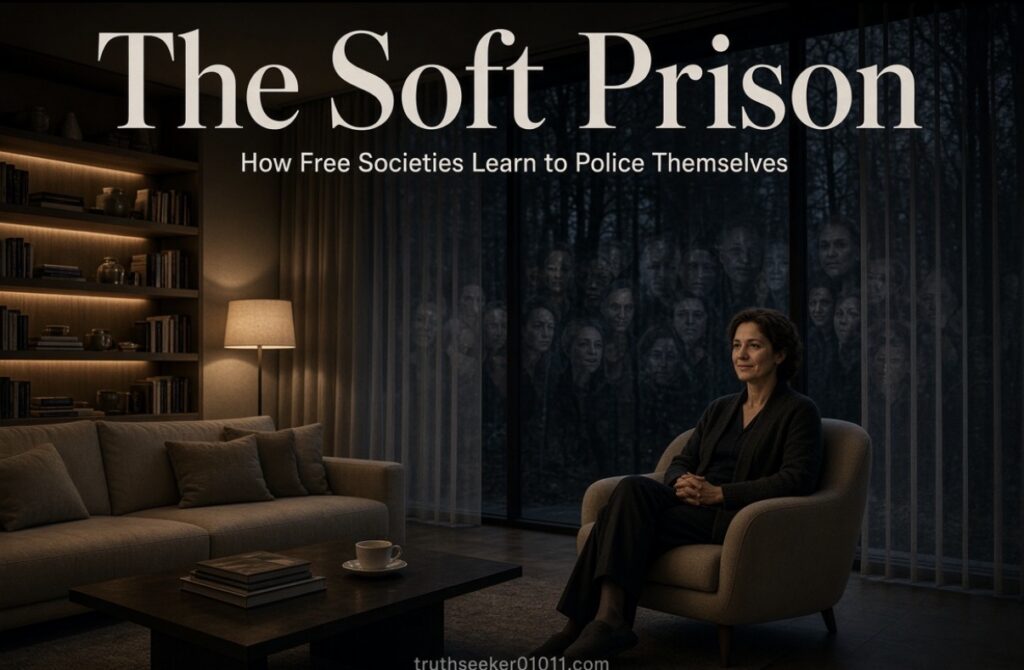
The most effective prison may be the one that does not look like a prison.
There are no bars.
No guards stand at the door.
No one necessarily forces you to remain inside.
Instead, you are taught from an early age what is acceptable, what is unacceptable, what opinions are respectable, what opinions are dangerous, and which parts of yourself should remain hidden if you want to belong.
Eventually, the door does not need to be locked.
You learn not to walk toward it.
This is the paradox of modern free societies. We often imagine oppression as something obvious: censorship, imprisonment, violence, surveillance, and authoritarian government. Those things certainly exist throughout history and in parts of the world today. But social control does not always require such visible instruments.
A society can regulate behavior through culture, incentives, reputation, economic dependence, social approval, and fear of exclusion.
The citizen becomes both prisoner and guard. And perhaps the most remarkable part is that the guard is often invisible.
The first stage is normalization
No government needs to seize complete control overnight. In fact, dramatic attempts at control often provoke resistance. A more durable transformation happens incrementally.
A new rule appears to solve a specific problem. A new institution is created to address a particular crisis. A new restriction is justified as temporary. A new government program promises to protect people from a legitimate danger.
Individually, each step may appear reasonable.
But societies rarely experience political change as a series of isolated decisions. They experience it cumulatively. The boundary of acceptable government authority moves. What once seemed extraordinary becomes familiar. What once seemed unacceptable becomes negotiable. And what once seemed temporary becomes permanent.
The human mind adapts remarkably well to changing circumstances. Once people become accustomed to something, they stop asking whether it should have been accepted in the first place.
The question changes from:
“Should the government have this power?”
to:
“How should the government use the power it already has?”
That is a profound psychological transformation. The existence of the authority is no longer debated.
Only its application is.
The second stage is dependency
Freedom is frequently discussed as though it were only about rights.
But freedom also involves responsibility.
To be free means, at least in part, to make choices without someone else guaranteeing the outcome.
That can be frightening.
People want security. They want predictable healthcare, education, employment, housing, retirement, protection from crime, economic stability, and assistance when life goes wrong.
Governments can provide many legitimate public goods.
But every system that provides security also creates relationships of dependence.
The danger begins when citizens gradually lose the capacity—or willingness—to imagine solving problems without government intervention.
The psychological bargain becomes increasingly attractive:
Give the state more responsibility, and the state will give you more security.
For an individual facing uncertainty, that can seem entirely rational.
But dependency changes political behavior.
If your livelihood, benefits, professional environment, education, or future security is increasingly connected to institutions controlled by the state, opposing those institutions can become more difficult.
You may still be legally free to disagree.
But freedom on paper and freedom in practice are not always identical.
The third stage is moralization
This may be the most powerful mechanism of all.
Political questions gradually become moral questions.
Instead of debating whether a policy works, people begin debating whether supporting the policy makes someone a good person.
Instead of saying:
“I disagree with you.”
society begins saying:
“People like you are the problem.”
Once political beliefs become attached to personal morality, disagreement becomes dangerous.
If a political position represents compassion, then opposition can be portrayed as cruelty.
If another position represents justice, opposition can be portrayed as hatred.
If another represents freedom, opposition can be portrayed as selfishness.
The policy itself becomes secondary.
The identity becomes primary.
And once someone’s political identity becomes part of their moral identity, changing their mind becomes psychologically expensive.
They aren’t simply admitting that they misunderstood a policy.
They may feel as though they are admitting that they misunderstood themselves.
That is why political polarization can become so intense even when people are arguing about ordinary questions of taxation, education, immigration, healthcare, speech, regulation, or social policy.
The disagreement is no longer about government.
It is about who deserves to be considered a good person.
The fourth stage is social enforcement
This is where the soft prison becomes truly effective.
A government does not have to punish every unacceptable opinion.
Society can do it for them.
People are extraordinarily sensitive to social rejection. Humans evolved as social creatures, and exclusion has always carried enormous psychological consequences.
Therefore, control does not always require someone to say:
“You are forbidden from saying that.”
Sometimes all that is necessary is:
“People will think badly of you if you say that.”
The result is self-censorship.
People begin calculating before they speak.
What can I say at work?
What can I say around my friends?
What can I say publicly?
What will happen if someone misunderstands me?
Will I lose my reputation?
Will someone report me?
Will I be excluded?
Will people assume something about my character?
Eventually, people stop asking what they actually believe. They ask what they are permitted to say. And when enough people do this, something extraordinary happens. The society begins to appear more unanimous than it really is. Silence is mistaken for agreement. Conformity is mistaken for consensus. Fear is mistaken for acceptance.
The fifth stage is the disappearance of the censor
At the beginning of a system of social control, someone may have to enforce the rules. Eventually, people enforce them themselves. This is the most sophisticated form of conformity. The citizen anticipates the reaction before speaking. The employee anticipates the consequences before questioning a policy. The student learns which opinions receive approval. The professional learns which subjects are dangerous. The parent teaches the child what not to say. No one necessarily has to issue an order. The rules have become internalized. The external authority has moved inside the individual. At that point, society has achieved something far more efficient than constant coercion. It has created self-policing citizens.
But this is not unique to one political ideology
There is an important distinction here. The soft prison is not inherently left-wing or right-wing. It can emerge from any ideology.
A society obsessed with equality can pressure people to conform in the name of fairness. A society obsessed with nationalism can pressure people to conform in the name of patriotism. A society obsessed with tradition can pressure people to conform in the name of morality. A society obsessed with individualism can pressure people to conform through economic and social competition. The mechanism is broader than any particular political philosophy. The danger begins whenever a society decides that there is only one morally legitimate way to live. Because once a government or culture moves from saying:
“You are free to choose.”
to:
“You are free to choose correctly.”
freedom has already begun changing meaning.
Canada and Europe provide an important question
Canada and European democracies are useful examples to examine precisely because they are not conventional dictatorships.
Their political systems contain elections, competing parties, courts, civil institutions, independent journalism, and significant legal protections.
That makes the question more interesting, not less. How much authority will free citizens voluntarily accept? How much responsibility will they voluntarily surrender? How much conformity will they tolerate in exchange for social harmony? And how much disagreement can a society absorb before disagreement itself becomes viewed as antisocial? These are not questions that can be answered simply by calling citizens “brainwashed.”
People support government policies for many reasons. Sometimes they genuinely believe those policies are beneficial. Sometimes they prioritize collective goals over individual autonomy. Sometimes they trust institutions because those institutions have earned that trust. Those explanations deserve to be taken seriously. But so does the possibility that social conditioning influences what people perceive as reasonable in the first place. The most powerful assumptions are often the ones we never think to question.
The final stage is identity
Eventually, political systems can become intertwined with personal identity. A person no longer merely lives under a particular system. They become emotionally attached to it. Criticizing the system feels like criticizing them. This is where political loyalty can become remarkably resistant to evidence. If information threatens the belief, the individual may reject the information rather than reconsider the belief. The system becomes part of the person’s understanding of themselves. And this is where freedom becomes particularly fragile. Because a free society requires something psychologically difficult:
the ability to question the institutions you depend upon.



5 thoughts on “The Soft Prison: How Free Societies Learn to Police Themselves”
You have good insight. And you exercized your freedom to move elsewhere. I love your posts on instagram. Keep up the great work.
You have good insight. And you exercized your freedom to move elsewhere. I love your posts on instagram. Keep up the great work.
Very thought provoking. I’m looking forward to sharing this essay with my kids.
I love your videos and now your articles! They are thought provoking and modern. I could read something from a famous author that doesn’t have your insight! Keep up the great work! If Canada doesn’t appreciate you, the USA does!
The Overton window moves. That’s how a once considered liberal president like JFK becomes conservative and unelectable by liberals. Of course, nowadays anybody who is not INSANE is unelectable by the Libtards. That window is moving at warp speed these days and the glass is all broken!
Freedom as in FREE. That’s the ultimate ticket. It can be found in the woods. Wilderness is a little piece of God’s mind. Go there hiking or backpacking, spend time there and you immerse yourself in the mind of God, and you will feel it. The only realities and pressures there are thirst, hunger, energy, exhaustion, light, dark, wind and harsh beauty. All natural, as they say. Nature speaks to our soul of a hundred thousand years. It feels real. It feels right. It feels like being home, short of being on the ‘other’ side.
Your eyes drink in the trees, the quivering leaves, wind through the pine needles, the scent in the air, dappled light, mountains, streams and lakes. It doesn’t stop when it goes into your eyes. It goes straight to your soul and you feel whole and whom you actually are. Duality evaporates, time loses its importance and you are one. That is real freedom. The city and suburbs are a man-made hellhole of fake reality, delusion and pain. A shallow simulation of what we think is divine. We are but an infant race. No one is as stupid as us. And nothing has more potential.