
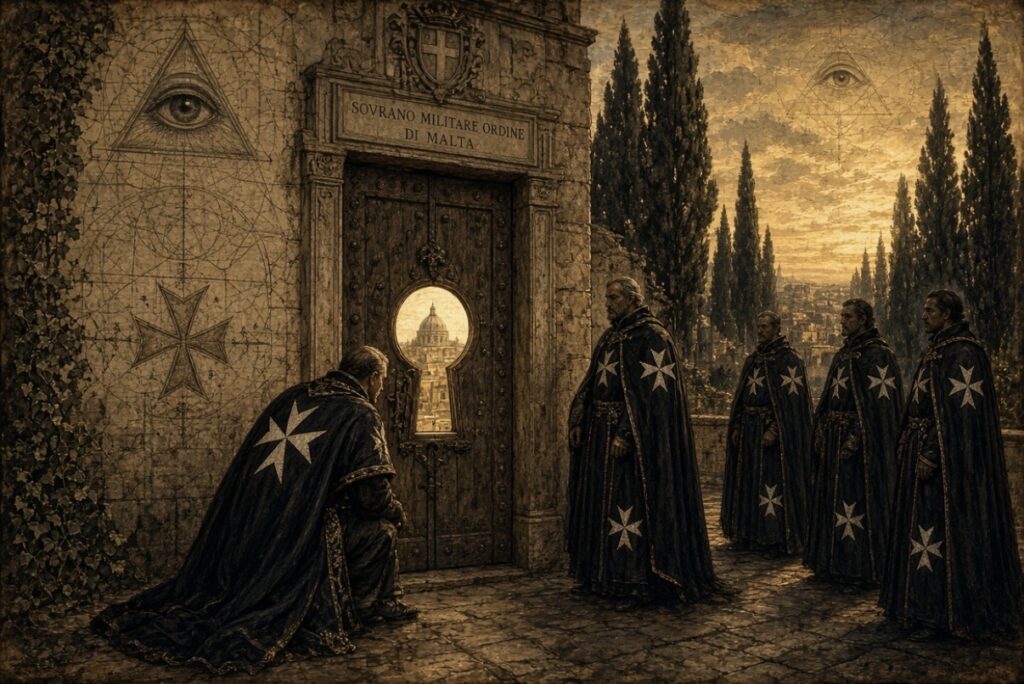
The Sovereign Military Hospitaller Order of St. John of Jerusalem, of Rhodes and of Malta—commonly called the Order of Malta—is one of the world’s oldest religious and humanitarian institutions. It is headquartered in Rome, Italy, and is unusual because it possesses many characteristics of a sovereign state without being a conventional country. The Order has a government, diplomatic relations, passports, and a permanent observer mission at the United Nations. At the same time, it has no ordinary population, elected territorial government, or independent national territory comparable to Italy, France, or the United States. Its modern identity developed through nearly a thousand years of religious, military, diplomatic, and charitable service.
The history of the Order began in Jerusalem during the second half of the eleventh century. A community associated with merchants from Amalfi established a church, convent, and hospital dedicated to Saint John the Baptist to care for pilgrims and the sick. Under the leadership of Blessed Gerard, the organization developed into the religious community known as the Hospitallers. On February 15, 1113, Pope Paschal II formally recognized the Order through the papal bull Pie postulatio voluntatis. This recognition allowed the Order to elect its own superiors and placed it under the protection of the Church. (orderofmalta.int)
At first, the Order’s principal purpose was charitable and medical. However, during the Crusades, it also became responsible for protecting pilgrims and defending Christian territories in the Holy Land. After the Crusader states declined, the Hospitallers moved from Jerusalem to Cyprus and then to the island of Rhodes. In 1530, Holy Roman Emperor Charles V granted the Order the islands of Malta, Gozo, and Comino. From that period onward, it became widely known as the Order of Malta. Its government operated from Malta for centuries, and the Order maintained naval and military forces while continuing its hospital and charitable activities.
The Order lost control of Malta in 1798 when Napoleon Bonaparte invaded the island. Because the Order’s religious rules prevented it from fighting another Christian ruler, it surrendered Malta and was forced to seek a new headquarters. After several temporary arrangements, the Order established its permanent seat in Rome in 1834. Today, its government is based primarily at the Magistral Palace on Via Condotti and at the Magistral Villa on the Aventine Hill. These properties are located in Rome but enjoy extraterritorial rights under agreements with Italy. This arrangement does not mean that the Order owns a large territory surrounding the buildings. Rather, Italy recognizes the special legal status of the properties so that the Order can conduct its sovereign and diplomatic functions. (orderofmalta.int)
The Order’s claim to sovereignty comes from its long historical independence and its continuing recognition as a subject of international law. Its constitutional charter describes it as a lay religious order and a subject of international law. In practice, it maintains diplomatic relations with numerous countries, exchanges ambassadors, issues certain passports, and participates in international organizations. The Order currently reports diplomatic relations with 115 states and permanent observer status at the United Nations. These relationships are primarily intended to support its humanitarian work rather than to advance political or military interests. (orderofmalta.int)
For this reason, it is more accurate to describe the Order of Malta as a sovereign religious institution or non-territorial subject of international law than as a normal country. It does not have a broad geographic territory, a conventional economy, or a general population living inside its borders. Its sovereignty is institutional and historical rather than territorial. This makes it comparable in some ways to other entities that possess international legal personality without functioning as ordinary nation-states.
The question of who the Order’s “citizens” are is also unusual. Membership in the Order is not the same as citizenship in a country. Members are admitted to a religious and chivalric institution, not automatically granted nationality in the ordinary sense. The Order includes Knights and Dames, religious members, chaplains, and other participants who support its mission. Its full religious members are known as Knights of Justice, who take religious vows and hold a distinctive position within the Order. Other members may be admitted because of their commitment to Catholic values, charitable service, and humanitarian work. Although the Order historically emphasized aristocratic ancestry, its modern membership places greater importance on character, service, and commitment. (orderofmalta.int)
The Order does issue passports, but these are not ordinary travel documents available to everyone who joins. Its diplomatic passports are restricted mainly to the Grand Master, members of the Sovereign Council, heads and members of diplomatic missions, their immediate families in certain circumstances, Grand Priors, and presidents of national associations. It also issues service passports for certain officials. Therefore, most members of the Order do not possess an “Order of Malta passport,” and membership should not be confused with holding citizenship in a conventional country. (orderofmalta.int)
The Order operates internationally through national associations, volunteer organizations, diplomatic missions, medical institutions, and relief agencies. According to its official information, it works in approximately 130 countries through national associations, volunteer corps, hospitals, medical centers, foundations, and the worldwide relief agency Malteser International. Its activities include emergency medical assistance, disaster relief, refugee support, care for the elderly and disabled, ambulance services, food assistance, and health-care programs. (orderofmalta.int)
Its humanitarian work takes place across Europe, Africa, the Americas, Asia, and Oceania. The Order has been involved in assistance programs in areas affected by war, poverty, natural disasters, displacement, and disease. Examples cited by the Order include Ukraine, Syria, Iraq, Myanmar, Haiti, South Sudan, the Democratic Republic of the Congo, Pakistan, the Philippines, Nepal, and parts of Southeast Asia. Through diplomatic agreements, its medical and relief programs can cooperate with national governments and sometimes gain access to regions where other international organizations face restrictions. (orderofmalta.int)
Diplomacy is therefore closely connected to the Order’s charitable mission. Its embassies help arrange humanitarian access, import medical supplies, coordinate with governments, and support emergency operations. The Order also maintains permanent observer missions to United Nations offices in New York, Geneva, Rome, and Vienna, as well as a mission accredited to UNESCO in Paris. It has diplomatic or official relationships with the European Union and other international organizations. (maltaembassy.orderofmalta.int
In conclusion, the Order of Malta became sovereign through its medieval history as an independent religious and military order, its rule over Rhodes and Malta, and its continued recognition after losing its territorial possessions. Its headquarters in Rome are not the capital of a typical territorial country but the administrative center of a sovereign institution with extraterritorial properties. Its members are Knights, Dames, religious officials, and volunteers—not a normal national population—and only certain senior officials receive its passports. Today, the Order’s most important role is humanitarian. It operates through medical programs, relief agencies, national associations, volunteers, and diplomatic missions in approximately 130 countries, continuing the hospital tradition that began in Jerusalem nearly a thousand years ago.
Sources
1. Sovereign Military Order of Malta, “History.”
2. Sovereign Military Order of Malta, “Mission.”
3. Sovereign Military Order of Malta, Constitutional Charter and Code, 2022.
4. Sovereign Military Order of Malta, “Bilateral Relations.”
5. Sovereign Military Order of Malta, “Humanitarian Diplomacy.”
6. Sovereign Military Order of Malta, “Multilateral Relations.”
7. Sovereign Military Order of Malta, “Passports.”
8. Sovereign Military Order of Malta, “FAQ: Membership and the Order’s Mission.”




1 thought on “The Order of Malta in Rome: Sovereignty, Citizenship, and Global Operations”
There are only 2 obSERVER States of the UN ~ The State of Palestine and the Holy See ~ the word “See” in this context comes from the Latin word sedes, which means “seat.” It refers to the episcopal seat or the jurisdiction of the Pope in Rome.