
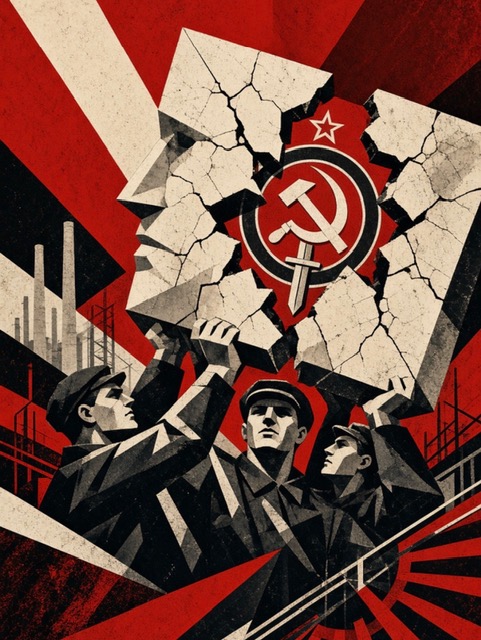
Bolshevik Propaganda and the Creation of Controlled Opposition
When people hear the term propaganda, they often think of posters, newspapers and political speeches designed to persuade people to support a government. The Bolsheviks understood propaganda as something much broader.
After seizing power in 1917, Vladimir Lenin and the Bolsheviks understood that controlling Russia required more than defeating their political opponents militarily. They needed to control information, define who was considered legitimate, discredit competing movements and, eventually, make it extremely difficult for genuine opposition to organize independently.
One of the most revealing parts of this system was the development of political deception and controlled opposition.
It is important to distinguish two things. The Bolsheviks primarily eliminated or suppressed genuine political opposition inside Russia. But their secret police also developed sophisticated operations in which they created or controlled fake opposition organizations in order to identify, manipulate and neutralize real opponents. The best-known example was Operation Trust in the 1920s.
The basic principle was remarkably simple:
If you cannot safely allow your enemies to organize, control the organization they believe is opposing you.
Step 1: Control the information environment
The first step was controlling what people could read and hear.
Immediately after the October Revolution, the Bolsheviks moved against independent newspapers. The government issued a decree restricting the press within days of taking power, while newspapers hostile to the new regime were closed. The Library of Congress describes the suppression of newspapers as initially presented as temporary but eventually becoming a permanent feature of Bolshevik rule.
Meanwhile, newspapers such as Pravda became official Communist Party organs. The Library of Congress records Pravda as the official organ of the Bolshevik party beginning in November 1917.
The Bolsheviks also understood the importance of visual propaganda.
During the Civil War, ROSTA produced large illustrated posters that communicated political messages, military developments and revolutionary ideology to people who might have had little access to conventional newspapers.
The objective was not simply to tell people what to think.
It was to establish which information counted as legitimate information in the first place.
If the government controls the major newspapers, publishing networks and public messaging systems, an opposition movement has to fight not only the government but also the government’s ability to define reality for the population.
Step 2: Define the enemy
The next step was identifying categories of people who could be portrayed as threats to the revolution.
The Bolsheviks frequently described political opponents as counterrevolutionaries, bourgeois enemies, saboteurs or agents of hostile powers.
This was politically useful because it transformed an ordinary disagreement into a question of national survival.
Instead of:
“This political group disagrees with the government.”
The message became:
“This political group is working against the revolution.”
That distinction matters enormously.
Once opposition is classified as an existential threat, extraordinary measures become easier to justify.
The Bolsheviks used this logic during the Russian Civil War, when the new government faced armed opposition, foreign intervention and competing revolutionary movements. The Library of Congress documents the early use of the Cheka to investigate supposed counterrevolutionary crimes and its subsequent expansion into a powerful instrument of repression.
Step 3: Eliminate genuine political competition
The Bolsheviks did not initially eliminate every competing socialist party immediately.
There were still Mensheviks, Socialist Revolutionaries and other political forces after the October Revolution.
But the political environment became progressively less permissive.
The Bolsheviks dissolved the elected Constituent Assembly in January 1918 after it failed to recognize their political authority. The Assembly had been elected by millions of Russians, with Socialist Revolutionaries winning substantially more seats than the Bolsheviks.
Opposition newspapers were closed.
Political organizations were restricted.
The Cheka arrested opponents.
The Socialist Revolutionaries and Mensheviks were increasingly suppressed, particularly as the Civil War intensified. By 1921, the Cheka was arresting large numbers of Mensheviks.
The result was crucial:
The regime increasingly prevented independent opposition from developing into a competing source of political power.
That distinction is important because a government does not need to manufacture every opponent if it can simply prevent independent opponents from acquiring enough organizational capacity to challenge it.
Step 4: Build the security apparatus
The Bolsheviks created the Cheka in December 1917.
Officially, its original mission was combating counterrevolution and sabotage.
In practice, its authority expanded rapidly.
The Library of Congress describes the Cheka as becoming an institution with powers of summary justice and a central role in suppressing enemies of Bolshevism.
This created another critical element of political control:
Opposition was no longer simply a political problem. It became an intelligence problem.
The government wanted to know:
Who is organizing?
Who is financing them?
Who communicates with foreigners?
Who distributes information?
Who recruits new members?
Who is planning violence?
Who is sympathetic but not yet involved?
This is where controlled opposition becomes particularly useful.
Instead of merely arresting everyone suspected of opposition, intelligence services could sometimes allow an organization to continue operating while secretly monitoring it.
That could reveal an entire network.
Step 5: Turn opposition into an intelligence trap
This is where Operation Trust becomes one of the most extraordinary examples.
Beginning in the early 1920s, Soviet security officials created a fake anti-Bolshevik organization known as the Monarchist Union of Central Russia.
To genuine anti-Bolsheviks abroad, the organization appeared to represent an underground resistance movement operating inside Soviet Russia.
It wasn’t.
It was controlled by the Soviet security apparatus.
The operation was designed to attract genuine opponents who believed they had discovered an underground movement capable of challenging the Soviet government.
The genius of the operation was that the Soviets didn’t merely tell their enemies:
“We have an underground organization.”
They created circumstances in which their enemies discovered the organization themselves.
That made the deception considerably more believable.
Step 6: Give the fake opposition believable people
A completely artificial organization would have been easy to expose.
So the Soviets used people who had genuine connections to the old Russian political and administrative establishment.
One important figure was Alexander Yakushev, a former imperial official who became involved in the operation and served as an important intermediary with Russian émigrés abroad.
This gave the fake organization credibility.
The people encountering it were not necessarily communicating with obviously fictional characters.
They encountered individuals who appeared to have legitimate backgrounds, connections and knowledge of events inside Russia.
The deception therefore became psychologically convincing.
Step 7: Make the opposition believe it is succeeding
This was perhaps the most sophisticated part.
A fake opposition organization cannot simply exist.
It has to provide its supporters with evidence that it is real.
Operation Trust therefore created the impression that an underground network existed inside the Soviet state and that sympathetic officials, military officers and others were prepared to help overthrow the regime.
The organization could therefore tell foreign opponents:
“Wait.”
“We are building our network.”
“We are not ready yet.”
“More people are joining.”
“The Soviet government is weaker than it appears.”
That kept opponents invested.
Instead of abandoning the effort because nothing was happening, they interpreted the lack of action as evidence that the organization was being careful.
The opposition was effectively kept permanently waiting for the moment when it would supposedly become powerful enough to act.
Step 8: Use the fake opposition to identify the real opposition
This was the central intelligence purpose.
Once genuine anti-Bolshevik organizations contacted the fake organization, Soviet intelligence could learn:
- who the real opponents were;
- who was financing them;
- who was communicating with foreign governments;
- who was attempting to enter Soviet territory;
- what plans they were discussing;
- and which individuals could be recruited, arrested or monitored.
Instead of searching for every opponent individually, the Soviet security apparatus created a single controlled doorway through which many opponents could be identified.
The Naval Postgraduate School’s historical analysis describes Operation Trust as a counterintelligence operation in which the fake underground helped identify anti-Soviet forces and direct their activities into channels controlled by the GPU.
Step 9: Feed the opposition information
The operation went beyond simply identifying people.
The Soviets could also control what their opponents believed.
False information could be provided through the fake organization.
The opposition could be encouraged to believe that the Soviet government was weaker than it actually was, that sympathetic officials existed inside the government, or that particular actions would produce useful results.
This created a powerful asymmetry.
The genuine opponents believed they were gathering intelligence about the Soviet government.
In reality, the Soviet government was gathering intelligence about them while simultaneously influencing what they believed about the Soviet government.
That is the essence of controlled opposition.
Step 10: Keep the operation alive
The final requirement was credibility over time.
If the fake organization suddenly disappeared, its supporters might become suspicious.
So the deception had to evolve.
Contacts continued.
Messages continued.
Plans were discussed.
Individuals traveled.
Information was exchanged.
The organization maintained enough apparent activity to remain believable.
Operation Trust continued for years and became one of the most famous examples of Soviet counterintelligence deception. Academic scholarship describes it as a major example of Soviet “provocation”—the deliberate creation or manipulation of an apparent opposition movement for intelligence purposes.
The larger Bolshevik system
The lesson of the Bolshevik period is not that every visible opponent was secretly controlled by the government.
That would go beyond the evidence.
The more historically defensible conclusion is more interesting.
The Bolsheviks used two complementary strategies.
First, they suppressed genuine independent opposition through censorship, arrests, political restrictions and the security apparatus.
Second, when useful, they infiltrated, manipulated or even created apparent opposition organizations to identify and neutralize enemies.
These methods reinforced each other.
If independent opposition is suppressed, people looking for an alternative become more desperate for information and connections.
That makes a convincing fake opposition network more valuable.
The regime could therefore create an environment in which genuine political alternatives were difficult to establish while simultaneously manipulating some of the remaining opposition from within.
The fundamental lesson
The most important lesson from the Bolshevik experience is that propaganda was not simply about putting posters on walls and telling citizens that communism was good.
It was a system.
Control the information.
Define the enemy.
Suppress independent political organizations.
Build an intelligence service capable of monitoring dissent.
Identify genuine opposition networks.