
How to Prepare for What’s Coming
Most serious disruptions are not cinematic. They are regional, temporary, and uneven: a power outage that lasts days, a supply-chain snag, a job loss, a storm, a currency or banking friction, or a stretch of civil disorder that makes ordinary errands unreliable. Preparation is the unglamorous work of reducing how much any one of those events can do to you. The goal is not a bunker fantasy. It is a household that can cover food, water, cash, heat, and basic medical needs for weeks without depending on a truck that may not arrive.
Money and finances come first because cash flow fails before shelves do. Keep a small amount of physical cash in small bills at home, enough for fuel, food, and incidentals if card networks or ATMs stall. Reduce high-interest debt where you can; a payment you no longer owe is resilience. Hold an emergency fund in an account you can actually reach, and do not keep every liquid dollar in one institution. Diversify a little: some cash, some ordinary savings, and, if it fits your situation, a modest allocation to assets that are not purely someone else’s promise to pay. Know your monthly burn rate. A written budget and a list of bills you can pause are more useful in a crunch than a complicated investment thesis.
Knowing what is coming means watching local conditions more than distant headlines. Weather services, utility outage maps, employer notices, and municipal alerts matter more than remote speculation. Learn the failure modes that actually hit your area: ice and heating loss in the north, heat and water stress in the south, flood zones, wildfire corridors, or supply routes that close when a single highway or port stops. Have a family plan for where you meet if phones fail, and keep paper copies of IDs, insurance, prescriptions, and key contacts.
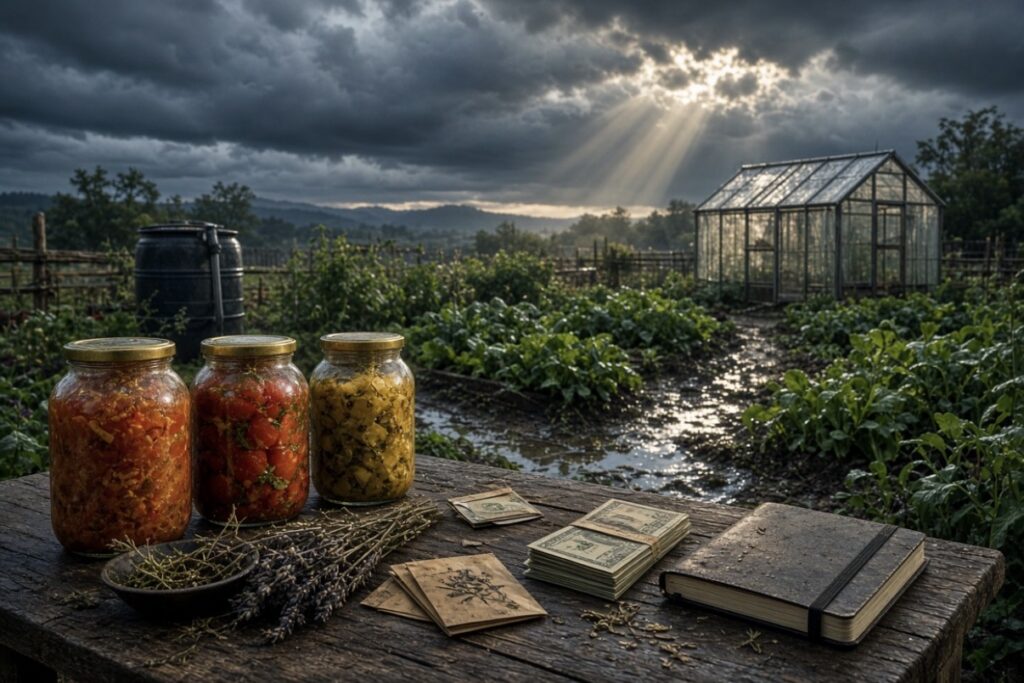
Food preservation extends what you already buy. Canning low-acid foods safely requires a pressure canner and tested recipes; water-bath canning is for high-acid foods only. Freezing works until the power does not. Dehydrating and freeze-drying stretch storage life if you control moisture and oxygen. Simpler methods still count: root-cellaring hardy vegetables, salting or fermenting where you know the process, and rotating a deep pantry of rice, beans, oats, oil, salt, sugar, canned fish, and peanut butter. Store what you eat, and date it. A two-to-four-week buffer is a practical first target; longer stores make sense only after the short one is solid.
General preparation is mostly redundancy. Water is the constraint people underestimate: store some, know how to treat more, and keep a way to carry it. A gravity filter, unscented bleach for emergency disinfection at the proper dilution, and a pot you can boil in cover most short outages. Light, a way to cook without the grid, blankets or a safe heat source, basic tools, and a first-aid kit with medications you actually use belong in the same category. Important documents and a small amount of cash should be grab-and-go, not buried in a drawer.
Short-term survival techniques depend on the environment. In cold climates, the priority is staying dry and insulated: layer clothing, keep a hat and spare socks, and know how to shut off water so pipes do not burst. In heat, shade, water, and avoiding midday exertion matter more than gear. In flood country, know your elevation and evacuation route before the water rises. In wildfire zones, a go-bag and a cleared perimeter beat heroics. Everywhere, the same short list applies for the first seventy-two hours: water, shelter from the actual weather, calories, a way to signal, and not getting injured while improvising. Practice the skills once in normal conditions so the first time is not the emergency.
Gardening skills turn storage into production, but only on a delay. Start with crops that match your season and soil: potatoes, beans, winter squash, kale, onions, and herbs are more forgiving than novelty vegetables. Learn your frost dates, how to start seed indoors, and how to save seed from open-pollinated plants. Compost, mulch, and simple irrigation matter more than equipment. A small plot or containers will not feed a household through a bad year by themselves, but they extend calories, vitamins, and the habit of producing something when stores run thin. Preserve the surplus the same season you grow it.
None of this requires predicting a single catastrophe. It requires assuming that normal systems sometimes pause, and arranging food, water, cash, skills, and a bit of home production so a pause does not become a crisis. Start with the two-week layer. Everything else is an extension of that.




3 thoughts on “How to Prepare for What’s Coming”
Thank you for your truth and knowledge. You are the future. Many blessings to you and your hubby. If you are ever up in Regina you will always have a place to stay.
Definitely relevant now, yet country folks have been doing this for generations. I see that a lot of the younger people don’t understand this, even in my own family.
I cant find the link for the first aid kit with antibiotics.