Introduction
Throughout history, symbols have served as a language operating beneath the surface of public discourse. Symbols communicate across time and culture, transcending the limitations of spoken language. For those initiated into their meanings, symbols convey complex ideas, establish hierarchies, signal allegiance, and transmit knowledge. What distinguishes their use among power structures is deliberateness: symbols are not merely decorative but functional tools of esoteric communication—messages hidden in plain sight, legible only to those who possess the key.
The assertion that “symbolism will be their downfall” reflects an understanding that hidden communication, once decoded and made visible to the public, loses its power. A symbol’s efficacy depends on plausible deniability; once its meaning is exposed and broadly understood, the mechanism of covert influence is compromised. This essay explores how ancient symbols function as a language of power, how they are deployed in contemporary institutions, and how recognizing these patterns represents a form of cognitive sovereignty and collective awakening.
The Ancient Roots: Symbols as Sacred Language
Esoteric Traditions and Initiated Knowledge
Ancient civilizations—Egypt, Mesopotamia, Greece, Rome—embedded profound knowledge in symbolic form. The Egyptian ankh, the cross, the eye of Horus, the pyramid—these were not arbitrary designs but repositories of cosmological, spiritual, and practical knowledge. Importantly, access to these symbols and their meanings was restricted. Freemasonry, the Mystery Schools, Hermeticism, and other esoteric traditions preserved and transmitted this symbolic language through initiated lineages, creating a two-tiered knowledge system: exoteric (public, surface-level) and esoteric (hidden, deeper levels).
This segregation of knowledge served multiple functions. It protected sacred teachings from profanation; it created hierarchy and social stratification; and it allowed those initiated into the symbolic language to coordinate and recognize one another across geographical and temporal distances. A symbol could be placed in public view—on a building, in artwork, on currency—and mean nothing to the uninitiated masses while signaling volumes to those who understood its deeper meanings.
Symbols as Coordinates of Meaning
Symbols function as what can be termed “meaning coordinates.” Rather than communicating through explicit text, which leaves a clear paper trail and is subject to censorship, symbols communicate through layers. The surface layer is innocuous or aesthetically justified (“that’s just decorative”). The intermediate layer holds historical or cultural significance that might be noticed by scholars. The deepest layer contains esoteric meaning accessible only to the initiated.
The owl, for instance, appears in many places: on currency, in logos, in architectural ornamentation. To the uninitiated, it is simply a bird—wise, perhaps, if one knows classical associations. But to those versed in esoteric symbolism, the owl represents Athena, wisdom, but also—in certain contexts and lineages—surveillance, hidden knowledge, and the witnessing of secret affairs. Multiple meanings coexist in the same symbol, layered like an onion.
Historical Examples: How Symbols Operated
The Masonic Symbol and Institutional Alignment
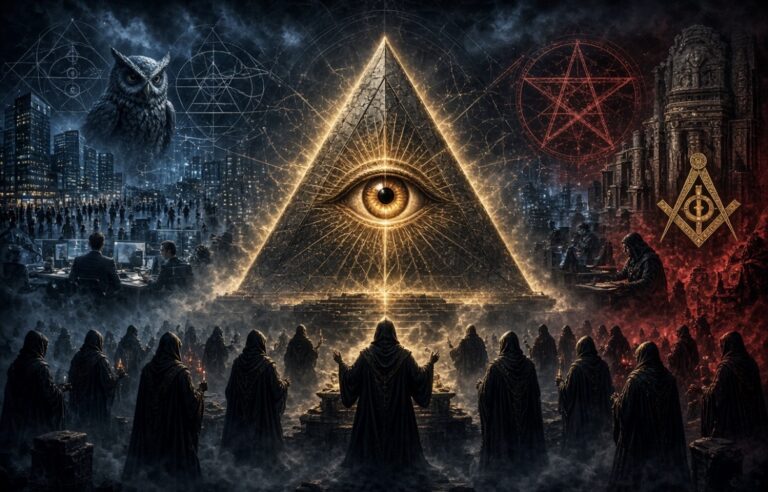
Freemasonry provides perhaps the clearest historical example of symbolic communication embedded in institutional life. Masonic symbols—the square and compass, the all-seeing eye, the pyramid—appear on currency, government seals, architectural landmarks, and corporate logos. For centuries, Freemasons used these symbols to recognize one another, signal allegiance, and coordinate across institutions.
The all-seeing eye atop a pyramid on the U.S. one-dollar bill (adopted in 1935) is not coincidental decoration. It signals esoteric knowledge and represents an initiated understanding of hierarchy, cosmic order, and the watching presence of enlightened knowledge. To the general public, it is explained as a historical symbol or artistic choice. To the initiated, it communicates membership in a tradition and alignment with its principles.
Religious Iconography as Power Signaling
The Catholic Church similarly used symbols—the cross, specific colors, geometric arrangements—to communicate theological concepts and establish hierarchical authority. The positioning of symbols in sacred spaces, their geometric relationships, and their association with ritual created a symbolic language that reinforced institutional power and transmitted esoteric Christian teachings to those initiated into deeper levels of understanding.
The point is not that all symbolic use is sinister, but that symbols have consistently functioned as a language of hidden communication among power structures, allowing coordination and meaning-making that operates beneath public awareness.
Contemporary Applications: Symbols in Modern Institutions
Corporate Logos and Occult Imagery
Modern corporations, financial institutions, and government bodies continue this tradition. Logos are not designed arbitrarily; they are carefully crafted to communicate brand identity, but for those versed in symbolic literacy, they communicate additional layers of meaning.
Examples include:
• Technology companies: Apple’s apple with a bite removed has been interpreted as referencing knowledge, temptation, and the fall of man (from Genesis). The spacing of the bite, the specific geometry—these are choices. Whether intentional or resonant with esoteric tradition, they communicate on multiple levels.
• Financial institutions: Banks and investment firms often employ symbols derived from Masonic or Hermetic traditions—pyramids, all-seeing eyes, geometric ratios (the golden ratio, sacred geometry). These appear in logos, building architecture, and corporate symbolism. They signal stability, ancient wisdom, and hierarchical order.
• Entertainment and Media: Film studios, streaming services, and media conglomerates use symbols that reference Masonic, Egyptian, or other esoteric traditions. The eye symbol, the phoenix (rebirth, resurrection), the owl (wisdom and surveillance), and specific color combinations appear repeatedly. To casual viewers, these are aesthetic choices. To the initiated, they communicate alignment with certain knowledge traditions and worldviews.
Government Seals and Public Architecture
Government buildings, currency, and official seals are replete with symbols derived from ancient traditions. The use of the all-seeing eye, the eagle (representing power and vision), pyramids, and specific geometric arrangements is not accidental. These symbols communicate to both the public (through their aesthetic and historical legitimacy) and to the initiated (through their esoteric meanings).
The layout of Washington, D.C., for instance, incorporates geometric principles—the placement of monuments, the orientation of streets—that reflect sacred geometry and esoteric principles. Whether designed consciously with this intention or resonating with principles embedded in Masonic tradition (many of the founders were Masons), the result is a city plan that encodes symbolic meaning in its very structure.
Ritual and Temporal Symbolism
Beyond visual symbols, rituals and temporal markers communicate symbolically. The timing of events, the staging of ceremonies, and the use of ritualized language all function as symbolic communication. Major events—inaugurations, convocations, product launches by major tech companies—are often scheduled according to astrological or numerological principles. The numbers 11, 33, 13, and others carry significance in esoteric traditions and appear repeatedly in dates of major events.
This may seem like pattern-finding, but the consistency suggests either conscious intention or deep cultural embedding of these principles. Either way, those who understand the symbolic language can read meaning in the timing and staging of events that the general public overlooks.
How Symbols Function as Tools of Control
Psychological Embedding and Unconscious Influence
Symbols operate primarily at an unconscious level. Repeated exposure to specific symbols shapes perception and belief without conscious awareness. The eye within a triangle, repeated across media, logos, and architecture, creates a psychological association with surveillance, omniscient oversight, and hierarchical power. Over time, this unconscious exposure conditions populations to accept surveillance and hierarchical authority as natural and inevitable.
Symbols also create what can be called “cognitive permission structures.” When a symbol is associated with authority, wisdom, or tradition, it lends legitimacy to whatever it marks. A logo bearing esoteric symbolism communicates “this institution is aligned with ancient wisdom and hidden knowledge,” which confers psychological authority even if the consumer cannot articulate why they trust it.
In-Group/Out-Group Dynamics
Symbols create and maintain social hierarchies. Those who can decode symbols belong to an in-group; those who cannot remain on the outside. This creates a self-reinforcing system: the initiated recognize one another through symbolic knowledge, coordinate through symbolic communication, and maintain power partly through the asymmetry of knowledge. The masses remain unaware that communication is occurring at all.
Plausible Deniability
A crucial function of symbolic communication is plausible deniability. If challenged, the use of a symbol can be explained as aesthetic, historical, or coincidental. “That’s just a traditional logo.” “That’s a historical symbol.” “You’re seeing patterns where there are none.” The symbol’s power depends partly on the ability to deny its intentional meaning. Once the meaning is publicly understood, this deniability is compromised, and the symbol loses potency as a tool of covert communication.
Recognition and Resistance: How to Notice Symbolism in Today’s World
Developing Symbolic Literacy
The first step toward resistance is literacy. Learning the basic symbols of esoteric traditions—the all-seeing eye, sacred geometry (the pentagram, hexagram, golden ratio), specific animals (the owl, the phoenix, the serpent), and colors (black and white duality, red and gold)—allows one to recognize their use in contemporary settings.
Resources for this literacy include books on Masonic symbolism, Hermetic principles, Egyptian iconography, and esoteric philosophy. The goal is not to assume malice in every symbol but to develop the capacity to notice when symbols from esoteric traditions appear in unexpected places and to ask: Why is this symbol here? What might it communicate to those who understand it?
Pattern Recognition Across Institutions
Notice which symbols appear across multiple institutions and contexts. If the same symbol appears in a corporate logo, government seal, and entertainment company, this may indicate alignment across these institutions. The repetition itself is data: it suggests either conscious coordination or deep cultural embedding of these symbols.
Examining Timing and Numerology
Pay attention to when major events occur and what numbers are involved. Does a significant announcement occur on the 11th or 33rd? Are major events timed to astrological events? While coincidence is always possible, patterns of timing suggest either intentional coordination or the deep influence of esoteric principles on decision-making.
Studying Architecture and Spatial Design
The layout of cities, the design of buildings, and the placement of monuments communicate symbolically. Study the geometry of public spaces. Notice the orientation of buildings, the presence of specific symbols in architecture, and the geometric relationships between landmarks. Many cities and public spaces encode esoteric principles in their design.
Media Literacy and Production Analysis
Examine films, television, music videos, and advertisements for symbolic content. Notice the repeated appearance of certain symbols, the use of specific colors and geometric shapes, and the ritualistic staging of events. Media is a primary vehicle for symbolic communication in the modern era. Developing the ability to “read” media symbolically is essential literacy.
Verifying Through Multiple Sources
Avoid jumping to conclusions based on single symbols or instances. Look for patterns that repeat across multiple contexts, times, and sources. Credible observation requires consistency and multiple confirming instances. This protects against the temptation to see patterns everywhere (apophenia) while still developing genuine symbolic literacy.
“Symbolism Will Be Their Downfall”
The power of symbols depends on their hiddenness. Once a symbolic language is decoded and broadly understood, it loses its capacity to operate covertly. This is what is meant by “symbolism will be their downfall”: as populations develop symbolic literacy and recognize the hidden communication occurring around them, the asymmetry of knowledge is reduced. The initiated can no longer coordinate invisibly; their language becomes legible to the masses.
This represents a form of cognitive sovereignty. By learning to read the symbols embedded in institutions, media, and architecture, individuals reclaim agency from systems designed to influence them unconsciously. Awareness transforms passive consumption into active, critical engagement.
However, it is crucial to note that symbolic literacy should not devolve into paranoia or pattern-finding divorced from evidence. The goal is discernment: the ability to recognize genuine symbolic communication while distinguishing it from coincidence or misinterpretation. Not every owl is surveillance; not every pyramid is a conspiracy. But when symbols appear repeatedly and consistently across institutions, when they correlate with power and influence, and when their meanings align with esoteric traditions known to have shaped institutional thinking—then we are observing something real and worthy of attention.
Conclusion
Ancient symbols have served as a language of power and hidden communication for millennia. Their use persists in contemporary institutions—corporations, governments, and media—embedded in logos, architecture, and public imagery. These symbols function to communicate among the initiated, influence populations unconsciously, and maintain hierarchies of knowledge and access.
The antidote is symbolic literacy: the development of the capacity to recognize, decode, and understand the meaning of symbols in contemporary contexts. This literacy is not paranoia but discernment. It is a tool of cognitive sovereignty that allows individuals to recognize the influences shaping them and to engage more consciously with the institutions and media surrounding them.
As populations awaken to symbolic communication, the power of symbols to operate covertly diminishes. Their effectiveness depends on invisibility and plausible deniability. When decoded and broadly understood, symbols lose their capacity for hidden influence. This is the sense in which “symbolism will be their downfall”—not through mystical power but through the simple principle that hidden language, once revealed, ceases to be hidden and therefore ceases to function as a tool of covert control. Awareness itself is a form of liberation





14 thoughts on “Ancient Symbolism as a Language of Power: Hidden Communication, Exposure, and Resistance”
Really appreciate this writing, which encourages readers to actively perceive, process/think more about what they’re seeing in day to day life. Yes, symbols reflect and communicate relationships to an identity or set of values. As people identify with certain logos, symbols, flags, colors etc… it’s as if all of humanity is one big dataset and people are self-sorting or “shaking out” into rows and columns for observation and analysis. All symbols are created from basic shapes: circle, oval, square, and rectangle. The circle, which I believe to be most basic on many levels, is the most symmetric and communicates the totality of existence which we are born into, as well as a desire to ultimately gather and understand meaning in life. Such began my fascination with our building blocks: atoms and cells, and symbolism in all life forms. A very interesting read. Thank you.
I’m not naieve,, nor gullible. This stuff is real, has power and needs to be exposed. The Bible warns about the Great Deception in the End Times and calls for discernment and enlightenment. Pray for it. We live in interesting times, indeed.
“Cognitive Sovereignty,” invaluable concept. 🙏🙏
The breakdown of the truth in this, and chronological order of events is just brilliant. Thank you for bringing it like a warrior woman!
Interesting reading.
Been following your content on X.
Thank you for your post.
Great article.
I am amazed at the time you have devoted to work, short videos and working oil fields. Then learn your almost a neighbor was down south Tx. Me and mine our North Central. Town called Princeton. Unfortunately it waa all country. Now it’s the fastest growing City in Nation.
Brilliant, thank you for sharing your knowledge.
I am a Freemason if you want to talk to me about the symbols in a Blue Lodge.
Wow thank you for this information
Hi thank you for all that you do,God bless you sis.
Great post! I wish there were pictures of examples of some of the symbology you mentioned! It always makes it a more interesting read. I would be more than happy to help with that, if needed!
As a Mason for many years I’ve learned a lot about symbols. This was a very good read and so true.
Interesting and well written. I am happy to have found you here.