
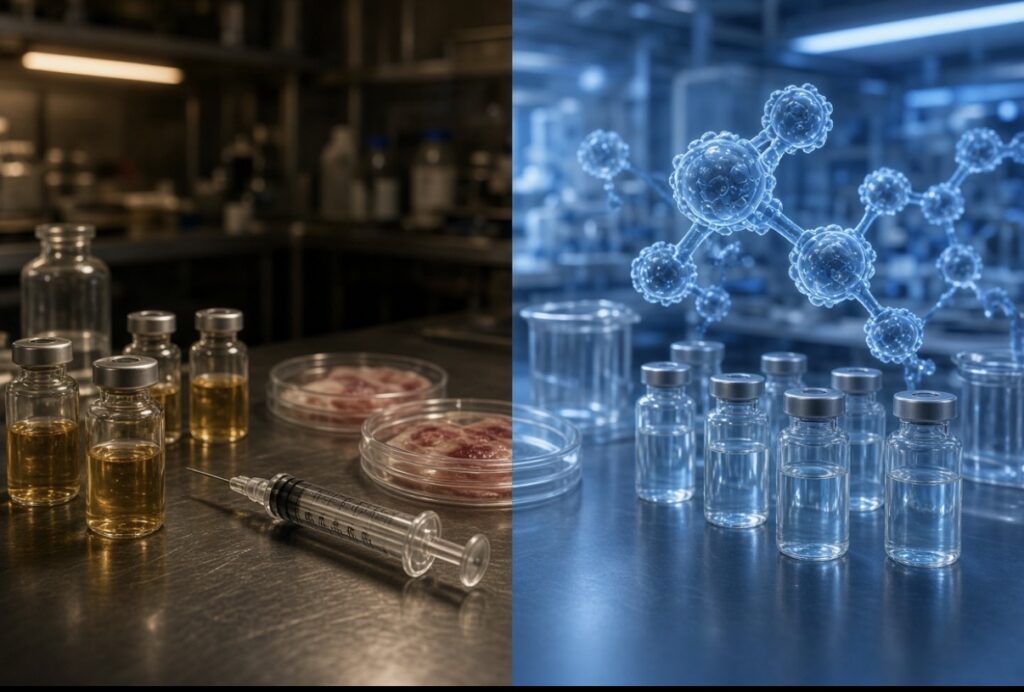
Traditional, mRNA, and Viral Vector Vaccines: How the Technologies Differ
Vaccines are often discussed as though they are one technology, but there are several fundamentally different ways a vaccine can introduce an antigen—or instructions for producing one—to the immune system.
The major categories include live-attenuated vaccines, inactivated vaccines, subunit and recombinant vaccines, toxoid vaccines, mRNA vaccines, and viral-vector vaccines. They all have the same broad objective: expose the immune system to something it can recognize so that it can develop an immune response and immune memory. The major difference is what the vaccine actually delivers to the body and how the antigen gets produced or presented. (World Health Organization)
The easiest way to understand the difference is to think of vaccines as using different ways of presenting a biological “wanted poster” to the immune system.
Traditional Vaccines
When people refer to “traditional vaccines,” they are generally talking about approaches that use either a whole microorganism or a component of it rather than giving cells genetic instructions for making the antigen.
There are several important types.
1. Live-Attenuated Vaccines
A live-attenuated vaccine uses a living version of a virus or bacterium that has been weakened.
The organism remains capable of limited replication, but it has been altered so that it generally does not produce the same disease as the naturally occurring organism.
Examples include the measles, mumps and rubella (MMR) vaccine and chickenpox vaccine. (CDC)
The basic process is:
Weakened microorganism → enters body → limited replication → immune system recognizes it → immune response develops.
Because the immune system encounters a living organism capable of limited replication, the resulting immune response can resemble aspects of the response generated by natural infection. (CDC)
2. Inactivated Vaccines
An inactivated vaccine uses a microorganism that has been killed or chemically or physically inactivated.
The important distinction is that the microorganism is no longer capable of replicating.
The vaccine can still contain recognizable structures from the microorganism, allowing the immune system to identify them as foreign.
The basic process is:
Inactivated microorganism → immune system encounters its antigens → immune response develops.
Examples include inactivated polio, hepatitis A and rabies vaccines. (CDC)
In this approach, the body is essentially being shown the target without being given a microorganism capable of reproducing itself.
3. Subunit and Recombinant Vaccines
A subunit vaccine goes a step further.
Instead of providing the entire microorganism, it provides only a specific component of it that the immune system can recognize.
That component might be a protein, sugar or combination of molecules.
Think of it as showing the immune system one recognizable part of the pathogen rather than the entire pathogen.
The basic process is:
Specific pathogen component → immune system recognizes antigen → immune response develops.
Some subunit vaccines use recombinant technology, meaning scientists produce the desired antigen using genetically engineered biological systems rather than obtaining the complete pathogen itself. (World Health Organization)
4. Toxoid Vaccines
Toxoid vaccines are slightly different.
Some bacteria cause disease partly because they produce toxins.
Instead of targeting the entire bacterium, a toxoid vaccine uses a toxin that has been chemically altered so it is no longer toxic but can still be recognized by the immune system.
The immune system then learns to recognize the toxin.
Tetanus and diphtheria vaccines are classic examples of toxoid technology. (HHS.gov)
The basic concept is:
Inactivated toxin → immune recognition → antibodies against the toxin.
The Major Change: Genetic Vaccines
mRNA and viral-vector vaccines introduce a different concept.
Rather than primarily delivering the finished antigen, these technologies deliver genetic instructions that allow cells to produce the antigen themselves.
The World Health Organization describes this as a genetic or nucleic-acid approach. Instead of providing the whole microorganism or a finished piece of it, the vaccine provides genetic information telling cells how to make a specific protein that the immune system can recognize. (World Health Organization)
This makes the body’s cells temporarily function as the manufacturing site for the antigen.
That is the fundamental conceptual difference.
mRNA Vaccines
Messenger RNA, or mRNA, is a naturally occurring molecule used by cells to carry instructions for making proteins.
A simple analogy is a recipe.
DNA is the cookbook.
mRNA is a temporary copy of one recipe.
The ribosome is the kitchen that follows the recipe.
An mRNA vaccine provides cells with a laboratory-produced RNA message containing instructions for making a particular antigen.
For the original COVID-19 mRNA vaccines, that message instructed cells to produce a version of the SARS-CoV-2 spike protein. (CDC)
Step-by-Step: mRNA
1. Injection
The vaccine is administered into muscle tissue.
2. Delivery
The fragile mRNA is packaged inside microscopic lipid particles that help protect it and facilitate its entry into cells. (CDC)
3. Reading the instructions
The mRNA enters the cell’s cytoplasm, where ribosomes read its instructions.
4. Protein production
The cell produces the specified antigen.
5. Immune recognition
The antigen is processed and recognized by the immune system.
6. Immune response
B cells, T cells and other components of the immune system respond, producing immune memory.
7. Breakdown
The temporary mRNA is eventually broken down by normal cellular processes.
A critical point is that mRNA does not need to enter the cell nucleus to function. The mRNA is read in the cytoplasm by ribosomes. (CDC)
In simplified form:
mRNA vaccine → RNA instructions → cell produces antigen → immune system recognizes antigen → immune memory develops.
Viral Vector Vaccines
Viral-vector vaccines use another approach.
Instead of packaging mRNA directly into lipid particles, scientists use a modified virus as a delivery vehicle.
Think of this modified virus as a biological delivery truck.
The virus is engineered to carry genetic instructions for producing the desired antigen.
For COVID-19 vaccines, adenoviruses were used as vectors in some vaccine designs. The vector carried genetic instructions associated with the SARS-CoV-2 spike protein. (World Health Organization)
Step-by-Step: Viral Vector
1. Injection
The vaccine containing the modified viral vector is administered.
2. Cell entry
The vector interacts with cells and delivers its genetic material.
3. Genetic instructions are used
The delivered genetic information ultimately allows the cell to produce the target antigen.
4. Antigen production
The cell produces the protein specified by the delivered instructions.
5. Immune recognition
The immune system recognizes the antigen as foreign.
6. Immune response
Antibodies and cellular immune responses are generated, along with immune memory.
The important point is that the vector and the target pathogen are not the same thing. The vector is being used as a delivery platform for genetic instructions related to the pathogen being targeted. (World Health Organization)
In simplified form:
Viral vector → delivers genetic instructions → cell produces antigen → immune system recognizes antigen → immune memory develops.
The Key Difference Between mRNA and Viral Vector
The two technologies can ultimately lead to the same basic event: a person’s cells produce an antigen that the immune system recognizes.
The simplest comparison is:
Traditional whole-microbe vaccine:
“Here is the weakened or inactive target.”
Subunit vaccine:
“Here is an identifiable piece of the target.”
mRNA vaccine:
“Here are temporary instructions for your cells to make the target.”
Viral-vector vaccine:
“Here is a modified biological delivery vehicle carrying instructions for your cells to make the target.”
The Fundamental Technological Difference
The biggest technological distinction is therefore not simply “old versus new.”
It is what the vaccine delivers.
Traditional approaches can deliver the whole microorganism in a weakened or inactive form, a component of the microorganism, or an inactivated toxin.
Genetic approaches instead deliver instructions for cells to produce the antigen.
Within genetic approaches, mRNA and viral-vector vaccines differ primarily in their delivery systems.
mRNA vaccines directly deliver messenger RNA, generally using lipid particles.
Viral-vector vaccines use a modified virus as the carrier for genetic instructions.
In both cases, the body’s cells temporarily become the place where the target antigen is produced.
That is what makes these technologies conceptually different from traditional vaccines that place the antigen—or the microorganism containing the antigen—directly into the body.
Conclusion
Vaccines are not a single technology. They represent several different biological strategies for teaching the immune system what to recognize.
Traditional approaches include weakened organisms, inactivated organisms, specific pathogen components and inactivated toxins.
mRNA vaccines take another approach by providing temporary RNA instructions that cells use to produce a target antigen.
Viral-vector vaccines similarly deliver genetic instructions, but they use a modified virus as the delivery vehicle.
The easiest way to remember the distinction is:
Traditional vaccine: deliver the target or a piece of the target.
mRNA vaccine: deliver the instructions.
Viral-vector vaccine: use a modified virus to deliver the instructions.
All three approaches ultimately involve the immune system recognizing an antigen and developing an immune response. What changes from one technology to another is where the antigen comes from and how the biological information needed to produce or recognize it gets into the body





5 thoughts on “Traditional, mRNA, and Viral Vector Vaccines: How the Technologies Differ”
Just wanted to say, that you’re a good import. We got the better end of the deal when you came south.
Liked it and would say A+. Ever see the reports that come from early Mrna that its said to be toxic to every life form its been injected into? Thats real. Mrna is a great idea just not for people. Or animals plants maybe but making mutant process inside humans is never a good idea. People should be left to develope by human biological means. Not any form of artificial means. Nothing inhuman should ever be put into a human. Well cuz its inhuman. Yes? Mrna has killed alot of people. All across the world. The covid cold was not even a dangerous cold to 90% of the population and 80+% of people got injected with a bioweapon because they were told to. Largest man made death event in human history. Just give it time. Its all still cooking. Cuz that degradeing Mrna is still live and active in everyone. 6 years later. Not good at all. k
Dear Tajana,
You do look like a specialist, I have a grade 3 continuous education, and made it to college and a bit of university as a Free Student, we were called if I remember correctly, finished college in 1983, Pre- Med in Psychology but didn’t attend other classes… Whatever happened to pregnant female horse piss, don’t they use that anymore??? hihi
Lot’s of Love,
Cordially
What is the current thoughts on where alpha gal came from?
My X had 4 kids, that we know of. My son was the only child without Asperger’s.
My son only got one MMR vax, the rest got them all.
Yet they say there is no correlation.
Why are they hiding this?!