
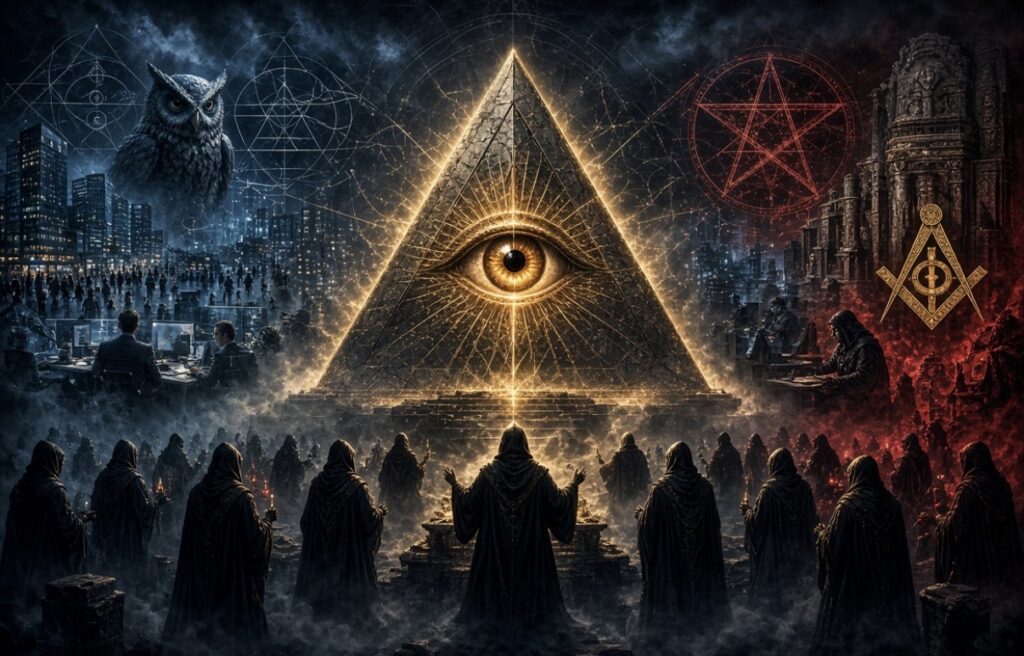
Introduction
Cults and secret societies operate through similar psychological and structural mechanisms, despite their different contexts and visibility. Understanding these systems—and the psychological vulnerabilities that make certain individuals susceptible to them—provides insight into how group loyalty can override individual critical thinking. This essay examines the core characteristics of cults, compares them to secret societies, explores personality factors that influence susceptibility, and considers how cult-like dynamics appear in modern political movements.
Part 1: Defining Cults and Their Core Characteristics
A cult is typically defined as a group centered on devotion to a leader or ideology, characterized by unquestioning loyalty, isolation from outside perspectives, and coercive control. Key characteristics include:
Authoritarian Leadership: A charismatic figure claims special knowledge, divine authority, or unique insight. Members accept this authority without critical evaluation.
Isolation: Physical or psychological separation from the outside world prevents members from accessing alternative viewpoints. This may involve cutting ties with family, limiting outside media, or creating an “us vs. them” mentality.
Ideological Rigidity: A closed belief system that cannot be questioned or revised. Contradictions within the ideology are rationalized rather than resolved.
Thought Control: Members are encouraged or coerced to adopt the group’s language, beliefs, and interpretations of reality. Dissent is discouraged through social pressure, shame, or punishment.
Exploitation: Members surrender personal autonomy, finances, sexuality, or labor for the group’s benefit, typically enriching the leader.
Information Control: Members receive carefully curated information; outside sources are demonized as hostile or corrupt.
The Backbone of Cult Structures
For a cult to function, several foundational elements must exist:
1. A Compelling Narrative: A coherent worldview that explains the world and promises salvation, enlightenment, or special status to members.
2. Psychological Leverage: Knowledge of human vulnerabilities—loneliness, existential anxiety, desire for belonging, need for meaning—which the group exploits.
3. Incremental Commitment: New members are gradually drawn deeper through escalating demands of loyalty, financial contribution, or behavioral change. Small commitments lead to larger ones through cognitive dissonance.
4. Social Enforcement: Peer pressure and community cohesion enforce compliance. Leaving becomes psychologically costly.
5. Leader Dependency: Members learn to rely on the leader for interpretation of reality, decision-making, and validation.
Part 2: Secret Societies and Hierarchical Knowledge
Secret societies function similarly to cults but with key structural differences. They typically operate within mainstream society rather than in isolation, and they employ hierarchical systems of knowledge revelation.
Tiered Information Structure: Members are initiated into successive levels, each revealing “deeper truths.” This creates psychological investment—members must advance to access promised knowledge. Examples include Freemasonry (with its degree system) and esoteric organizations like Hermetic Orders.
Selective Membership: Exclusivity creates status and strengthens in-group identity. The promise of “secret knowledge” unavailable to outsiders is a powerful draw.
Institutional Legitimacy: Many secret societies operate within respected institutions (universities, governments, business), lending credibility and providing protection from scrutiny.
Loyalty Through Secrecy: Members are bound by oaths and the shared burden of keeping secrets, creating psychological bonding and preventing outside criticism.
Famous Cults
• Peoples Temple (Jim Jones): Ended in mass murder-suicide in Guyana (1978); combined religious doctrine with political ideology.
• Heaven’s Gate: Believed advanced aliens would rescue members via UFO; 39 members died in mass suicide (1997).
• Branch Davidians (David Koresh): Apocalyptic group that ended in deadly siege in Waco, Texas (1993).
• NXIVM: Led by Keith Raniere; used pseudo-science and coercion to exploit members financially and sexually.
• Aum Shinrikyo: Japanese doomsday cult that conducted the Tokyo subway sarin gas attack (1995).
Famous Secret Societies
• Freemasonry: Worldwide fraternal organization with hierarchical degree system; operates openly but keeps rituals secret.
• Skull and Bones (Yale University): Elite undergraduate society; members include prominent politicians and business leaders.
• Bohemian Grove: Exclusive club for powerful men; combines networking with ritualistic elements.
• The Order of the Illuminati (historical): 18th-century Bavarian group; has inspired extensive “conspiracy” theories.
Part 3: Psychological Susceptibility: Who Is Drawn to Cults?
Research in psychology identifies personality traits and life circumstances that correlate with cult susceptibility. Understanding these differences is crucial to recognizing that cult membership isn’t simply a sign of stupidity—it involves specific psychological vulnerabilities.
Factors Increasing Susceptibility
High Need for Certainty: Individuals uncomfortable with ambiguity, who find existential uncertainty distressing, are drawn to ideologies offering clear answers and absolute truth.
Low Critical Thinking or Education: While not determinative, less experience evaluating competing claims can reduce resistance to propaganda and logical fallacies.
Recent Life Disruption: Grief, loneliness, job loss, or identity crisis creates emotional vulnerability. Cults offer immediate community and sense of purpose.
Desire for Belonging: Those with weak social ties, social anxiety, or feelings of alienation are highly susceptible to the instant community and unconditional acceptance cults provide.
Magical Thinking: A tendency to find patterns, attribute causality liberally, and believe in special knowledge or hidden truths correlates with cult involvement.
High Suggestibility and Compliance: People with high respect for authority, or who struggle to assert themselves, more easily accept coercive control.
Neuroticism and Anxiety: Individuals with higher baseline anxiety may be drawn to groups promising security and protection.
Factors Providing Resistance
Strong Independent Identity: Those with secure sense of self are less threatened by the ideology’s challenges to individuality.
Developed Critical Thinking: Ability to identify logical fallacies, evaluate contradictions, and seek multiple sources of information provides resistance.
Stable Social Support: Strong existing relationships outside the group provide reality checks and alternative perspectives.
Psychological Resilience: Tolerance for ambiguity, comfort with uncertainty, and ability to self-soothe reduce vulnerability to the group’s certainty.
Prior Education on Manipulation: Explicit training in propaganda techniques, social influence, and cognitive biases provides inoculation against manipulation.
Internal Locus of Control: Those who believe they control their outcomes are less dependent on external authorities to interpret reality or provide meaning.
The Cult Recruitment Profile
The most effective cult recruitment targets people during specific windows: recent graduates, new arrivals to cities, those experiencing grief, or those in spiritual seeking phases. The group doesn’t create vulnerabilities so much as exploit existing ones.
Part 4: Cult-Like Dynamics in Modern Political Movements
This section examines how certain political movements employ cult-like mechanisms. The claim here focuses on campaigns by liberal/progressive political parties, though it’s worth noting that cult-like dynamics appear across the political spectrum.
Characteristics of Politically-Oriented Cult Dynamics
Charismatic Leadership and Personality Cult: Followers develop emotional attachment to political figures beyond policy evaluation. Criticism of the leader is experienced as personal betrayal. Campaign imagery emphasizes the leader’s special qualities or destiny.
Ideological Rigidity: A comprehensive political framework claims to explain complex social problems through a unified lens. Contradictions within the ideology are reframed rather than addressed. Policy failures are rationalized as insufficient commitment or external sabotage rather than flawed thinking.
Thought-Terminating Clichés: Rather than engaging substantive critiques, followers resort to dismissive phrases (“You just don’t understand,” “You’re on the wrong side of history,” “That’s been debunked”), which ends conversation and reinforces tribal thinking.
Social Enforcement and Purity Tests: Deviations from approved positions result in social ostracism, public shaming, or accusations of betrayal. “Cancel culture” functions as a loyalty mechanism. Ideological purity becomes more important than practical results.
Moral Absolutism: Political opponents are not merely wrong but morally corrupt, evil, or subhuman. This prevents genuine dialogue and justifies extreme rhetoric or actions against them.
Us vs. Them Mentality: The ingroup is portrayed as enlightened, moral, and victimized; the outgroup as ignorant, evil, and threatening. Conspiracy thinking flourishes (“The system is rigged against us”).
Emotional Reasoning Over Evidence: Policy positions are adopted based on emotional alignment with the group rather than empirical evaluation. Contradictory positions are held simultaneously without cognitive dissonance.
Specific Examples in Liberal Campaign Culture
The 2008 Obama Campaign: While not a cult per se, the campaign successfully cultivated emotional fervor that sometimes overrode critical evaluation. Some supporters continued strong loyalty despite policy contradictions (e.g., expansion of drone strikes, continuation of detention facilities) that conflicted with stated values.
Climate Catastrophism: While climate change is real and significant, some political messaging employs cult-like certainty regarding specific predictions and timelines. Contradictions (past failed predictions) are rationalized. Skeptics of particular proposed solutions are morally condemned rather than engaged.
Social Justice Movements (Intersectionality Framework): While social justice concerns are legitimate, certain expressions have adopted cult-like characteristics: rigid doctrinal purity, thought-terminating language (“You’re just exhibiting privilege”), shaming of dissenters, and ideological consistency prioritized over practical outcomes.
Anti-Trump Fixation: For some progressives, opposition to Trump became an identity and organizing principle so dominant that other issues or potential harms by “their side” were rationalized or ignored. Criticism of Democratic leadership was experienced as betrayal.
The Contradiction Problem
A hallmark of cult-like thinking is the acceptance of contradictions without resolution:
• Claiming moral superiority while employing dehumanizing rhetoric toward opponents
• Advocating for free speech while attempting to silence dissenters
• Promoting diversity while enforcing ideological uniformity
• Claiming scientific rationalism while adopting positions contradicted by evidence
• Denouncing “groupthink” while punishing independent thought within the group
When contradictions are pointed out, rather than being examined, they are rationalized through special pleading (“It’s different when we do it”) or dismissed entirely.
Why Political Movements Adopt Cult Dynamics
Several factors make political movements vulnerable to cult-like evolution:
1. Emotional Engagement: Politics now engages identity and belonging, not just policy preferences.
2. Tribal Competition: Polarization incentivizes loyalty signaling and outgroup demonization.
3. Digital Amplification: Social media algorithms reward emotional engagement, promoting extreme content and group polarization.
4. Loss of Traditional Communities: As religious and civic organizations decline, political movements increasingly fill the belonging need.
5. Complexity and Anxiety: Complex problems (economic inequality, climate change, identity questions) create anxiety; simplified ideological frameworks provide comfort.
Is This Unique to Liberals?
It’s important to note that cult-like dynamics appear across the political spectrum. Conservative movements display similar patterns (political cult of personality, moral absolutism, us-vs-them thinking, rationalization of contradictions). The specific content differs, but the psychological mechanisms are parallel. This essay focuses on liberal examples, but intellectual honesty requires acknowledging the phenomenon is not ideologically exclusive.
Conclusion
Cults, secret societies, and certain political movements exploit similar psychological vulnerabilities and employ comparable control mechanisms. The difference between a charismatic religious leader, an exclusive society’s hierarchical knowledge structure, and a political campaign’s emotional loyalty is often one of degree rather than kind.
Susceptibility to these systems is not a character flaw—it reflects normal human needs for belonging, certainty, and meaning. Understanding these dynamics is not about dismissing people caught in them, but about recognizing how institutions and movements can deliberately exploit psychological vulnerabilities.
The antidote to cult-like thinking—whether in religion, secret societies, or politics—involves:
• Cultivating comfort with uncertainty and ambiguity
• Maintaining independent relationships and viewpoints
• Prioritizing empirical evidence over emotional alignment
• Remaining willing to critique leaders and ideologies to which we’re attached
• Treating intellectual opponents as potentially correct rather than inherently corrupt
• Examining contradictions within our own beliefs rather than rationalizing them
A robust democracy depends on citizens who can resist cult-like dynamics across all ideological spaces.





1 thought on “Cults, Secret Societies, and Group Dynamics: A Comparative Analysis”
I do like how your mind works. You are one of the few unique individuals I’ve come across on the Internet.
I’m mainly interested in the secret societies. The people that believe they rule the earth, or are trying to.
I saw a post by you were you had a chart showing the connections between different groups.
I would be interested in reading more of your thoughts/writings about these issues.